What's the one metric that matters most?
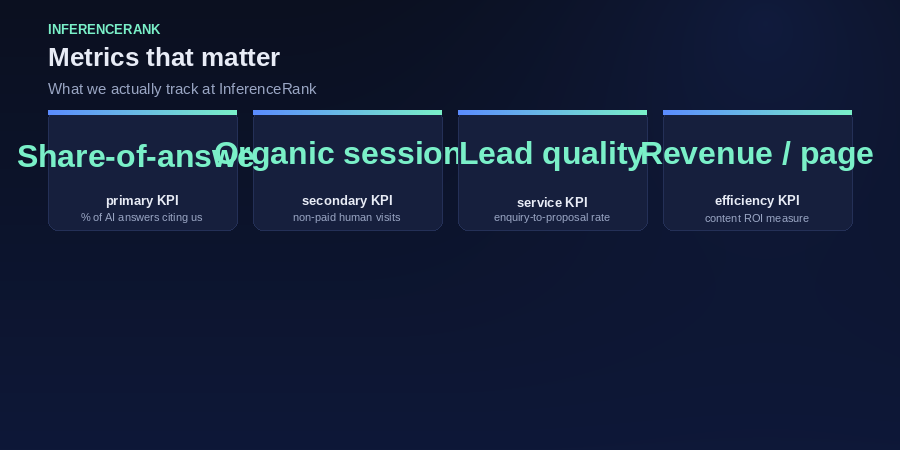
Share-of-answer: how often the AI engines cite us (or a client) for a fixed set of target questions, and how favorably. It's the closest thing to a north star because it sits directly on the outcome we sell — being the answer. Everything else either predicts it or follows from it. If share-of-answer is rising on the questions that matter, the strategy is working; if it's flat, something upstream needs attention.
Traditional SEO metrics — keyword rankings, domain authority — are lagging indicators for GEO. Share-of-answer is the leading indicator we care about most.
How do we measure our own visibility?
We run the same monitoring on ourselves that we sell. A fixed set of GEO questions gets asked across the major engines on a cadence, and we log whether LLM Results is cited, where, and in what light. Being our own first case study keeps us honest: we can't credibly promise clients a number we aren't tracking for our own site.
What about traffic and conversions?
Citations only matter if they move people, so we track the humans that arrive from AI engines and what they do next: referral visits, then the funnel from visitor to lead to client. We care far more about the shape of that funnel than its top-line volume — a hundred visitors who asked an assistant about GEO are worth more than ten thousand who bounced in from somewhere irrelevant.
What's our leading indicator?
Content coverage: how many target questions we own a strong, current page for. Share-of-answer and traffic are lagging — they move weeks after the work. Coverage moves the day we publish, and it reliably predicts the lagging numbers, so it's the metric we steer by day to day. The content roadmap exists to make coverage a deliberate line going up rather than a byproduct of motivation.
How do we track the business side?
Revenue, split by the lines in our monetization model: services first, then lead-gen, then ads. Keeping them separate tells us which engine is actually pulling, so we invest accordingly instead of guessing. We also watch the path from a piece of content to a booked engagement, because that link is what proves the whole flywheel pays.
Which metrics do we ignore?
Vanity numbers that feel good and decide nothing: raw pageviews with no intent behind them, follower counts, and above all any impression or visit driven by bots and crawlers. Crawler traffic is not an audience and never becomes revenue, so counting it would only flatter us into bad decisions. We'd rather track a small number of honest metrics well than a dashboard of impressive ones that don't.
How often do we look?
On a steady cadence rather than obsessively. Coverage updates as we publish; share-of-answer and the funnel get a weekly or biweekly review, because a single reading is noise and the trend is the signal. Checking too often invites overreaction to wobble; checking too rarely lets problems compound. The rhythm matters as much as the numbers.
The short version
One north star (share-of-answer), one leading indicator (content coverage), an honest funnel from citation to revenue, and a hard refusal to count anything a bot inflates. Few metrics, measured consistently, acted on deliberately.