How is this different from share-of-answer?
Share-of-answer measures whether the engines cite you; referral analytics measures the humans who then arrive. One is about visibility inside the answer, the other about traffic and behavior on your site. You want both: citations prove you're in the answer, referral data proves those citations move real people who do valuable things.
How do I identify AI referrers?
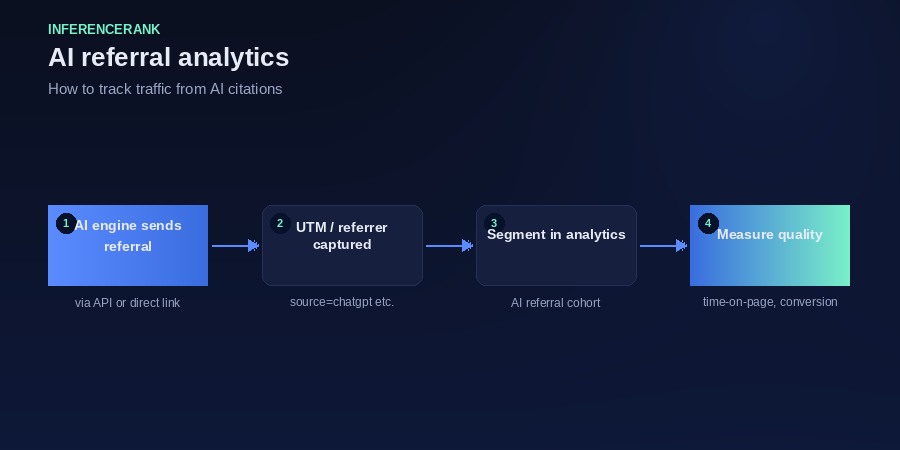
Visitors arriving from an assistant carry that source as a referrer — the domains of the major AI tools. In your analytics, look at referral sources and pick out those domains, then build a segment or channel grouping that bundles them as "AI assistants." Some sources arrive without a referrer, so this captures most but not every AI-driven visit.
Some AI engines append ?utm_source=chatgpt automatically. Others don't. Configure your analytics to catch the referrer header from chat.openai.com, perplexity.ai, and claude.ai regardless.
What should I measure about it?
The same things you'd measure for any valuable channel: how much of it there is, which pages it lands on, and what it does next — engagement, leads, conversions. AI referral traffic is often small but high-intent, since the visitor already got a recommendation, so judge it on quality and conversion, not raw volume.
How do I attribute it to GEO work?
Watch the trend after you publish or improve a page: rising AI referrals to that page, alongside rising share-of-answer for its question, is the signal your work landed. Pair the two datasets — citations and the humans they send — and you can connect a specific piece of content to real visitors and outcomes.
The short version
Find the AI assistant domains in your referral data, segment them, and measure volume, landing pages, and conversions. It's the human counterpart to share-of-answer — track both to see the full picture.