Why does an AI cite a competitor instead of you?
AI answer engines don't cite randomly — they pull from sources that answer the query clearly, carry authority signals the model has been trained to recognize, and contain information dense enough to be useful in isolation. When a competitor gets cited and you don't, one of three things is usually true: they cover the topic more completely, their facts are fresher, or their brand-to-topic association is stronger in the model's training data. You can rank higher than them in organic search and still lose to them in AI citations — because citation depends on extractability and authority depth, not just position.
How do you detect which queries you're losing?
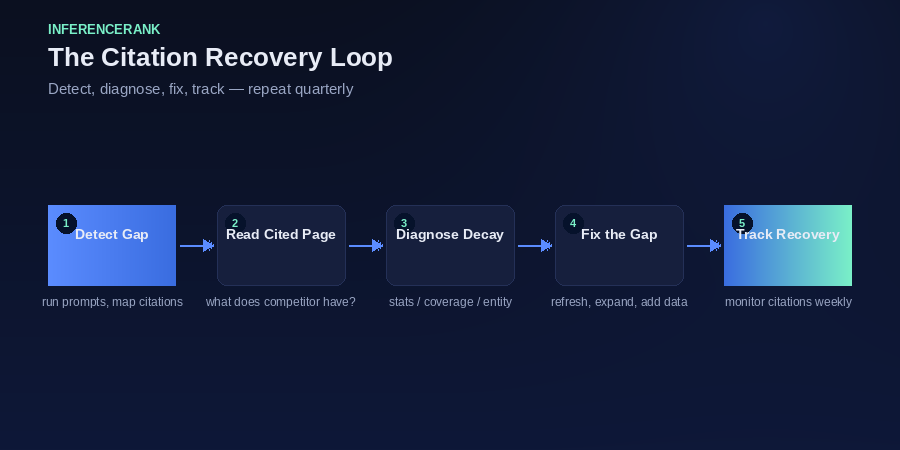
Run your target buyer prompts directly into each major AI engine — ChatGPT, Perplexity, Claude, Gemini, and Google AI Overviews. Document the full response and record every source cited in footnotes or inline links. Do this for 20–30 of the queries most important to your business. The pattern will be visible quickly: specific query types where a specific competitor appears consistently while you're absent. That's your citation gap map, and it tells you exactly where to focus.
The fastest diagnosis is reading what the AI actually cited. Open that page and ask: Does it lead with a more direct answer? Does it have a data table or numbered list where mine has prose? Does it cite a specific study or statistic that I don't? Does it cover an angle on the topic I skip? The answer is usually obvious within five minutes — and it tells you precisely what to build.
What are the three types of citation decay?
Citation gaps usually fall into one of three categories. Statistical decay means your data has gone stale — a competitor published fresher numbers, and the model now considers their source more reliable for fact-based queries. Competitive decay means someone published a more comprehensive or authoritative take on a topic you used to own — more specific, better structured, better sourced. Entity decay means your brand isn't clearly associated with the topic in the model's understanding — perhaps because your pages don't name the entities in your domain explicitly, or because third-party sources don't mention you in the right context. Each type has a different fix.
How do you fix a citation gap?
For statistical decay: refresh the page with current data, add a visible dateModified, and republish. For competitive decay: expand coverage on the topic, add original research or a data point only you can publish, and restructure the page around the questions the model is actually being asked. For entity decay: audit whether your pages state your brand name, product category, use cases, and target customers explicitly — not implied, stated plainly. Then build external entity associations by earning mentions in third-party directories, press coverage, and review sites where the model is likely to have ingested data.
How long does citation recovery take?
Longer than ranking changes. AI models have training data lag — updates to your content don't propagate instantly. For models with retrieval augmentation (Perplexity, Google AI Overviews), changes can show within days to weeks once your updated page is indexed and crawled. For models that rely more on training data (GPT-4o, Claude), the lag is longer and less predictable. This means the time to start recovery work is as soon as you detect a gap — not after you've lost the category to a competitor who then compounds their lead.
How do you track recovery progress?
Re-run the same prompts on the same cadence — weekly for high-priority queries, monthly for the broader set. Record whether you appear, where you appear relative to the competitor, and what the AI says about you when it does cite you (sentiment matters). Tools like Profound, Otterly AI, and Scrunch automate citation monitoring across engines and alert you to changes. The metric to track is share-of-answer per query: what fraction of AI responses on your target prompts now name you versus the competitor.
The short version
Detect which queries you're losing and to whom. Read the cited page. Diagnose whether the gap is stale data, shallow coverage, or weak entity associations. Fix the specific thing that's missing. Track citations on a regular cadence. Recovery isn't instant, but the diagnosis usually is.