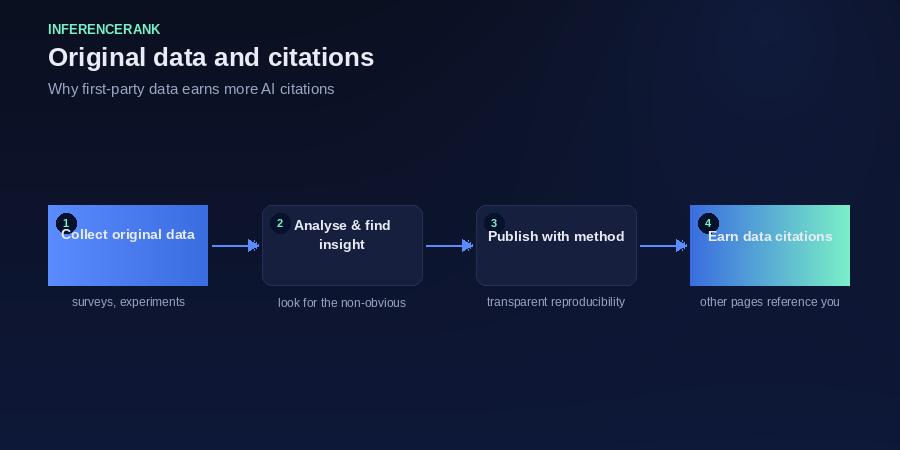
Why does original data get cited?
Because there's no alternative source for it. A model answering "what's the average X in this industry" will reach for a specific figure and name where it came from — and if that figure is yours alone, the citation is yours. Restating facts everyone already publishes makes you one option among many; publishing a unique fact makes you the option.
What kinds of data can I produce?
More than you'd think. A survey of your audience, a benchmark from anonymized product or industry data, a year-over-year analysis, a tally of something you're uniquely positioned to count — each yields numbers only you have. You don't need a research department; you need one honest, well-defined question and the data to answer it.
You don't need thousands of respondents. A survey of 50–100 people in a specific niche, published transparently with methodology, gives AI engines something unique to attribute to you.
How do I present it to be quotable?
State the headline finding plainly and early, in a single self-contained sentence with the number in it — "In our survey of 500 marketers, 38% said…" Give the figure context, explain your method briefly so it's trustworthy, and make the key stats easy to find rather than buried in a chart. A model quotes a clear sentence far more readily than an image.
How do I make it trustworthy?
Show your work. State sample size, time period, and method, and don't overclaim beyond what the data supports. Credibility is what turns a number into a citable fact; a striking statistic with no methodology reads as marketing and gets discounted. Honest, modest, and well-documented beats impressive and vague.
How do I get the data discovered?
Make it the centerpiece of a page built to be found — clear title, answer-first summary, and the standard crawlability and structured-data hygiene — then let others reference it. Original data tends to attract mentions and links, which compounds your authority and spreads the underlying fact (with your name attached) across the web.
The short version
Publish a fact only you have, lead with the number in a quotable sentence, document the method, and make the page easy to find. Original data turns you into the source a model must cite.