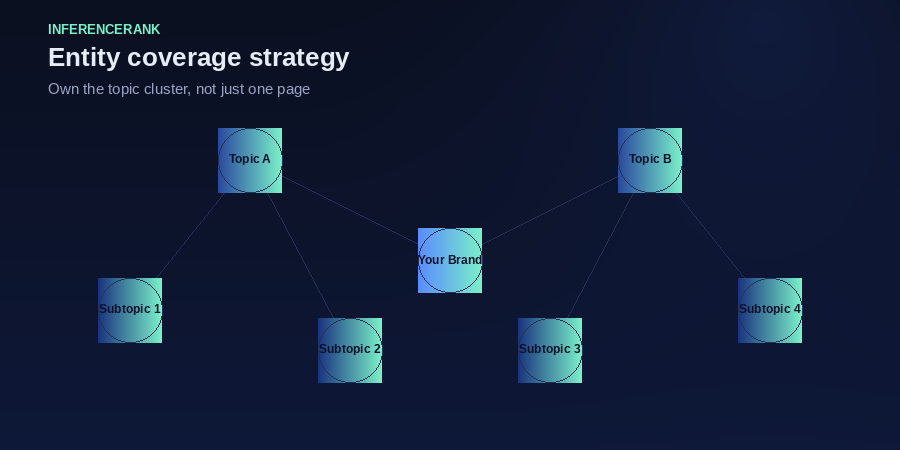
What exactly is an entity?
A distinct, identifiable thing rather than a string of letters. "Generative engine optimization" is a keyword; ChatGPT, Perplexity, schema.org, llms.txt, and Google AI Overviews are entities — specific things with their own identities and connections. Models build a web of these entities and reason over it, which is why naming the right ones matters more than hitting an exact phrase.
Why do models care about entities?
Because understanding a topic means understanding its parts and how they fit together. A page that names the relevant tools, standards, and concepts — and explains the relationships — demonstrates genuine command of the subject, which is exactly the signal a model uses to decide a source is worth trusting and quoting. Coverage reads as expertise; a thin page repeating one phrase reads as filler.
AI models build knowledge graphs from what they've processed. Consistent association between your brand and a topic cluster — across many pages and sources — increases your citation probability on that topic.
How do I find the entities for my topic?
Ask what a knowledgeable person would expect to see mentioned. List the tools, companies, standards, methods, and adjacent concepts in your area; look at what the top answers and sources already reference; and note the relationships — what depends on what, what competes with what. That list is your coverage checklist.
How do I cover them well?
Mention each relevant entity where it naturally belongs, and say something true about how it connects to the others — "llms.txt sits alongside robots.txt and your sitemap as a machine-facing file," not just a name-drop. Accuracy is the whole game; a wrong or forced relationship does more harm than a missing one. Breadth plus correctness is the target.
How is this different from keyword stuffing?
Keyword stuffing repeats the same phrase to game a match; entity coverage adds distinct, accurate information that a reader and a model both find useful. One inflates word count, the other increases genuine substance. If a mention teaches the reader something true, it's coverage; if it's just repetition, cut it.
The short version
Name the real things in your topic and explain how they relate, accurately and where they belong. Entity coverage is how you demonstrate expertise to a model — and it's the opposite of stuffing keywords.