What we choose to write
Every page targets a single question a real person would ask an AI assistant. We start from the prompts our audience actually uses — "how do I show up in ChatGPT," "what is generative engine optimization," "how do AI overviews pick sources" — and write one focused page per question. One question per page beats a sprawling pillar post, because retrieval matches a user's prompt against a tight, on-topic passage, not a page that covers ten things loosely.
Lead with the bottom line
The first paragraph of every page is a complete, self-contained answer that still makes sense if it's lifted out on its own. This is the single most-quoted element on a well-structured page, so it earns the most care. It doubles as the meta description and the social card text. A good test: read paragraph one in isolation — if it answers the question without the rest of the page, it's quotable. This is also the right way to "serve the bottom line to machines": make it visible, not hidden, so both readers and models get it.
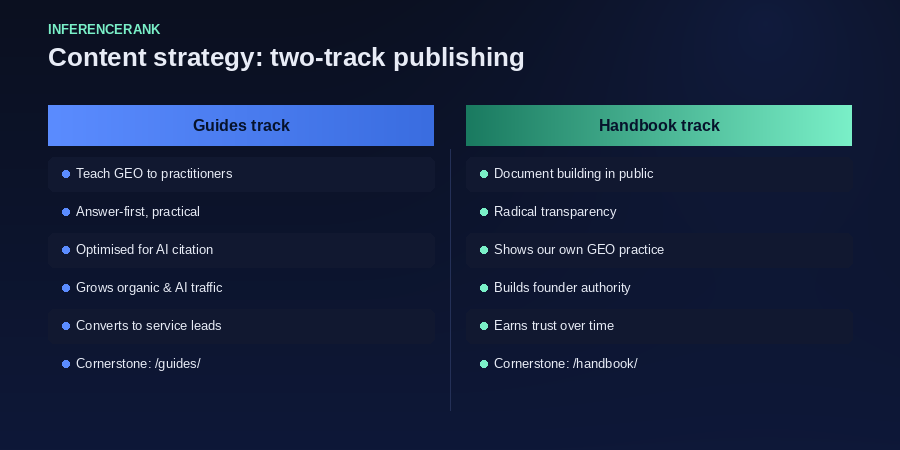
Every guide links to a relevant handbook chapter, and every handbook chapter links to the guides that demonstrate the principles. Readers enter either track and find the other naturally.
Structure around questions
Below the summary, every H2 is phrased the way people actually ask — "How much does it cost?", "How long does it take?", "Is it safe?" — with a tight answer beneath each. Question-shaped headings get pulled into answers far more often than clever, vague ones, because they mirror the shape of the prompt. Keep each section short enough to quote whole.
Cover the entities, not just the keywords
Language models reason over entities — the named things in a topic and how they relate. So we make sure each page names the relevant tools, standards, companies, and concepts, and states the relationships between them plainly. Breadth of accurate entity coverage signals genuine expertise to a model in a way keyword repetition never did.
Make every claim verifiable
We state facts with specifics — numbers, dates, named sources — rather than vague superlatives. "Serves roughly 20 billion ads a day" gives a model something concrete to attribute; "extremely popular" gives it nothing. Specificity also lowers the chance a model drops our page for a safer-looking source, and it keeps us honest.
Keep it current
Stale facts get filtered out, and this field moves monthly. So we date our pages, set a review cadence, and update figures as engines and numbers change. A page that's demonstrably maintained earns more trust from both readers and models than one frozen at publish date. Our build stamps and surfaces these dates automatically (see Chapter 1).
Measure share-of-answer
Rankings aren't the scoreboard anymore; citations are. We track, per target question, whether each major engine names us, what it says, and how that changes over time. That "share-of-answer" is the metric the whole strategy optimizes — and the thing we sell clients on improving.
The short version
One question per page, answer first, questions for headings, entities named, claims sourced, facts fresh. Do that consistently across a topic and you become the page the engines reach for.