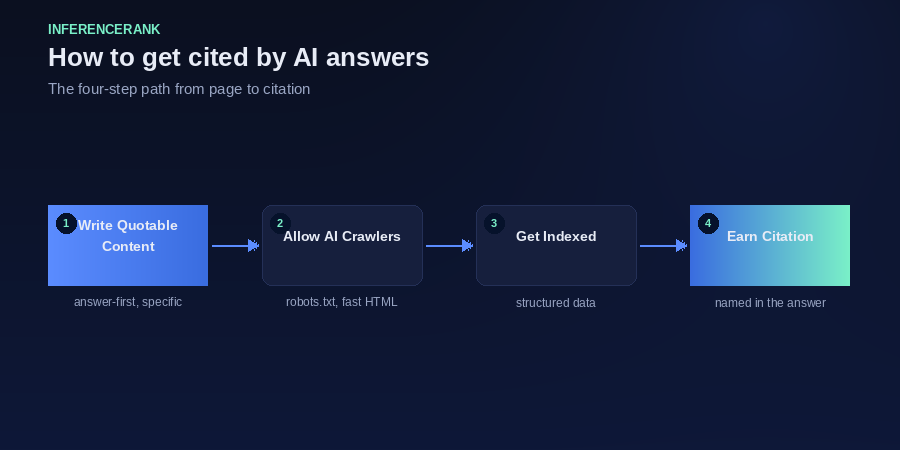
What "getting cited" actually means
When someone asks ChatGPT, Claude, Perplexity, or Google's AI Overviews a question, the engine retrieves candidate sources, summarizes them, and often names the ones it leaned on. Being one of those named sources is the goal of Generative Engine Optimization (GEO). Unlike a blue-link ranking, a citation puts your brand inside the answer itself — and sends the reader to you already primed.
Lead with a self-contained answer
Put a direct, complete answer in the first paragraph, written so it still makes sense if it's lifted out on its own. Models prefer passages that don't depend on surrounding context, because those are safe to quote. A good test: read your opening paragraph in isolation — if it answers the question without the rest of the page, it's quotable.
AI answer engines now handle more queries than traditional search for many information-seeking tasks. Being cited inside an answer — not just ranked below one — is increasingly where organic visibility lives.
Structure around real questions
Use H2 headings phrased the way people actually ask — "How much does it cost?", "Is it safe?", "How long does it take?" Retrieval systems match user prompts against this structure, so question-shaped headings with tight answers beneath them get pulled more often than clever, vague ones.
Make every claim verifiable
State facts plainly, attach numbers, and cite where they come from. Specifics ("supports 65,000 sites" rather than "widely used") give a model something concrete to attribute, and a named source reduces the chance it hedges or drops your page for a safer one. Keep facts current; stale figures get filtered out.
Cover the technical basics
None of the above matters if the engine can't read the page. Ship the substance as plain HTML that renders without JavaScript, keep pages fast, allow the major AI crawlers in robots.txt, and add structured data (schema.org) where it fits. The whole point is that a crawler or model reads your content without having to run code.
The short version
Answer first, structure around questions, source every claim, and keep the page machine-readable. Do that consistently and you stop competing for clicks and start being the answer.