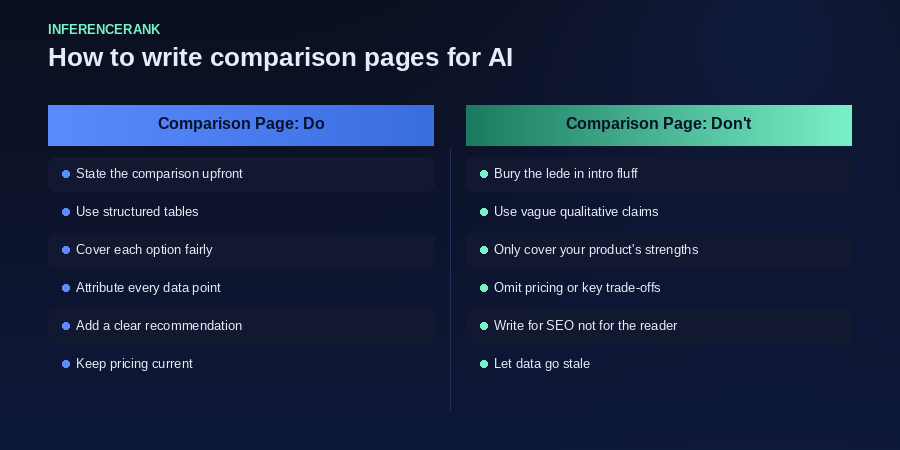
Why are comparisons so citable?
Comparative questions have comparative answers, and a page that already structures the trade-offs hands a model a ready-made response. When someone asks an assistant to compare two options, a page that lays out the relevant criteria and a clear bottom line is the easiest thing to quote — you've done the synthesis the model would otherwise have to assemble.
AI engines are sensitive to obvious bias. A comparison that acknowledges a competitor's genuine strengths is more likely to be cited as authoritative than one that only flatters your own product.
What structure works best?
Lead with a one-line verdict ("X is better for teams; Y for solo users"), then compare on a consistent set of criteria that actually matter for the decision, and close with a clear "best for" recommendation per option. Make each criterion its own quotable point. The reader — and the model — should be able to extract the answer at any level of detail.
How do I stay credible?
Be genuinely fair. State real strengths and weaknesses for every option, including ones you'd rather downplay, and base claims on specifics rather than vibes. A comparison that conveniently always favors one side reads as an ad, and both readers and models discount it. Trustworthy comparisons are the ones that admit the other option is better at something.
What if I'm comparing my own product?
Disclose it and be even more rigorous. You can absolutely compare your product to alternatives, but you have to be honest about where the alternatives win, and clear that it's your product being discussed. Earned trust from a fair self-comparison is worth far more than a citation won by a page nobody believes.
The short version
Lead with a verdict, compare on criteria that matter, give an honest "best for" per option, and stay scrupulously fair — disclosing any stake. Fair comparisons get cited; biased ones get ignored.