What does "answer-first" actually mean?
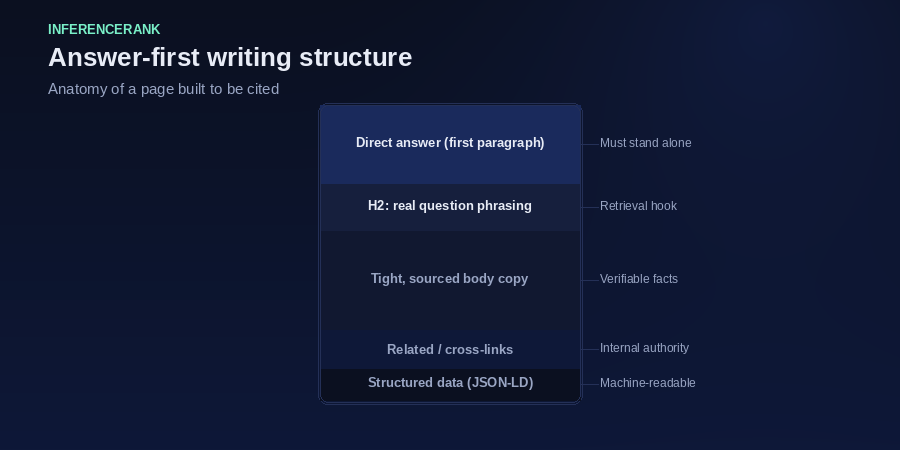
State the answer in the first paragraph, fully, before any setup or backstory. Inverted-pyramid style: conclusion first, detail after. The opening should resolve the question on its own, so a reader who stops after two sentences — or a model that quotes only those sentences — still gets something true and complete.
Cover the first two sentences of your page and read the rest. If the page still makes sense, your opener is probably just setup. Move your answer to the front.
How do I know my opener is self-contained?
Read the first paragraph in isolation, with the rest of the page hidden. If it answers the question without relying on a heading, an earlier sentence, or a "this" with no referent, it's self-contained. If it leans on context above or below, rewrite it until it stands alone.
What goes after the opener?
The "why" and the "how": the reasoning, the caveats, the steps, the evidence. Readers who want depth keep going; models pull supporting detail from here when a query needs more than the headline answer. Each section should still be quotable on its own, so keep them tight and on a single point.
Doesn't this make writing feel repetitive?
A little restatement is fine — the opener asserts, the body substantiates. The goal isn't to say everything twice; it's to make sure the most important thing is said first and clearly. Cut throat-clearing intros ("In today's fast-paced world…") entirely; they bury the answer and help no one.
The short version
Lead with the full answer, make it stand alone, then support it with quotable sections. Write so the first thing a reader or model sees is the thing they came for.