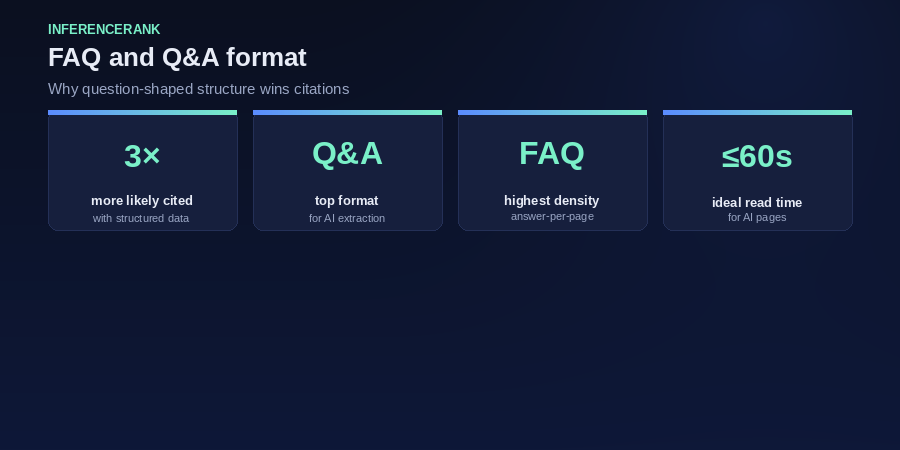
Why does Q&A format work for AI?
People ask assistants in questions, and a page already organized around those questions is a close match for the prompt — each question-and-answer pair is a self-contained unit a model can lift cleanly. It's the same answer-first principle applied at the section level: the question states the intent, the answer resolves it, and nothing depends on surrounding context.
Each FAQ item should be a single, direct question with a single, complete answer beneath it. Bundling multiple questions or hedging every answer reduces extractability.
What makes a good Q&A page?
Real questions phrased the way people actually ask them, each followed by a tight answer that stands on its own. Lead with the answer, keep each one focused on a single question, and order them the way curiosity flows. The quality bar is the same as any page — the Q&A shape just makes the structure explicit.
Should I add FAQ schema?
If the page has genuine FAQs, yes — FAQPage structured data tells machines exactly which text is a question and which is its answer, removing ambiguity. The rule is that the marked-up questions and answers must match what a visitor actually sees on the page. Schema describes real content; it doesn't conjure it.
When does Q&A formatting backfire?
When the questions are invented to host keywords, when answers are padded, or when you bolt an FAQ onto a page that has no real questions. That reads as manipulation to both readers and systems and can cost you trust. If you're inventing questions nobody asks, the format is wrong for that page.
The short version
Use Q&A where the questions are real: lead with the answer, keep each pair self-contained, and add FAQPage schema that mirrors the page. Don't fake questions to fit the format.