Why isn't one language enough?
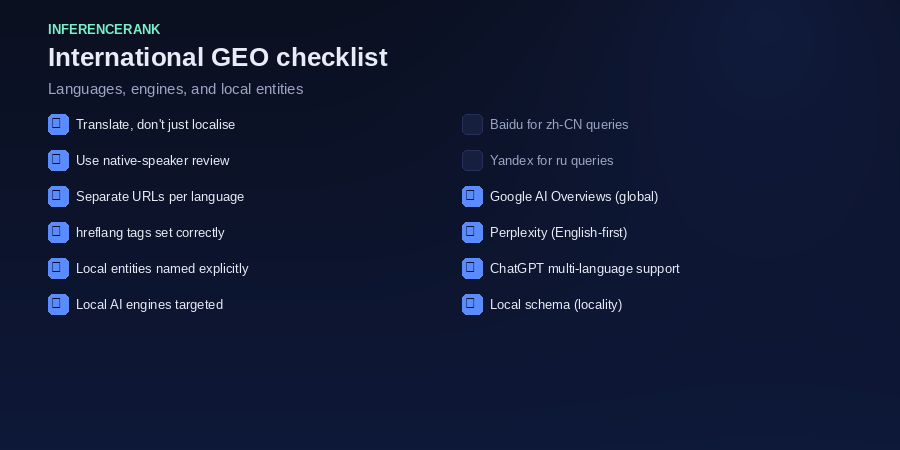
Because people ask in their own words, and an assistant answering a question in, say, German will prefer strong German-language sources. If your expertise only exists in one language, you're invisible to every query in the others. International GEO is the work of being a credible source in each language your buyers actually use.
Does machine translation work?
Rarely well enough. Cheap, unreviewed translation produces stilted text that misses idiom and nuance, and both readers and models discount it. Translation is a starting point at best; native review — ideally by someone who knows the market — is what turns it into content that reads as genuinely written for that audience.
Direct translation often misses how people phrase questions in another language. Research queries natively in each target language using the local AI engines your audience actually uses.
How do I signal language and region?
Make each page's language explicit in the markup, give different language versions clean, predictable URLs, and use the standard signals (such as hreflang) that tell systems which version serves which language or region. The point is to remove ambiguity about who each page is for, so the right version surfaces for the right query.
What about local accuracy?
Adapt facts, not just words. Prices, regulations, availability, examples, and norms differ by market, so a faithful translation of a fact that's wrong locally is still wrong. The most citable international content reads as written by someone who understands that market — which usually means it was.
The short version
Give each language genuine, native-quality content; signal language and region clearly; and make the facts locally true. Be a real source in each market, not a translated echo of one.