What is Organization schema?
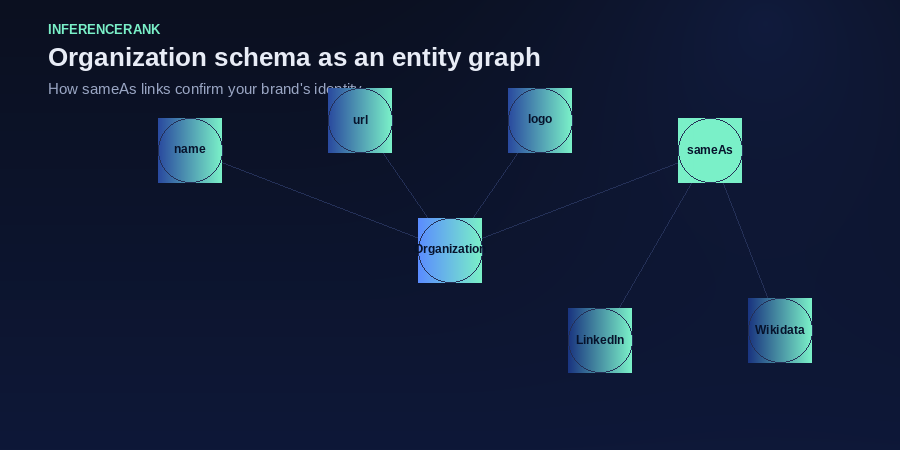
It's a block of schema.org structured data, written as JSON-LD, that describes your company as an entity rather than just a web page. At minimum it states a name, a canonical url, and a logo; in practice the most valuable part is sameAs — an array of links to the authoritative profiles that represent the same organization. You place it once, on the page that best represents the whole brand: your homepage.
Why do AI engines care about it?
Answer engines work with entities, not strings. Before a model will confidently name "Acme" in an answer, it has to be sure which Acme you are and that you're a real, consistent organization. Explicit Organization markup removes the guesswork: it ties your name to a logo, a website, and a set of corroborating profiles, which is exactly the evidence used to build a knowledge-graph entry. Without it, the engine infers your identity from scattered signals and is likelier to stay vague or cite a better-defined competitor.
Define the Organization once on your homepage with an @id like https://example.com/#org, then point to it from each page's Article or WebSite markup with {"@id": "https://example.com/#org"}. One source of truth, no conflicting copies.
Which fields matter most?
Start with name, url, and logo (an absolute URL to a clear, ideally square image). Add a one-sentence description, a foundingDate, and a contactPoint if you offer support. But the field that does the heaviest lifting for AI trust is sameAs — spend your effort there.
What is sameAs, and why is it the key signal?
sameAs lists other URLs that are unambiguously the same organization: your LinkedIn company page, your X/Twitter profile, your GitHub org, your Crunchbase entry, and — most valuable of all — your Wikipedia article and Wikidata item. These are independent, hard-to-fake references, so they corroborate your identity in a way self-description can't. A Wikidata entry in particular plugs you directly into the structured graph that many engines lean on. List the profiles that genuinely exist; never invent them.
Where should it live?
On your homepage, as a single Organization (or a more specific subtype like LocalBusiness or Corporation) node. Don't repeat a full Organization block on every page — that creates conflicting copies. Instead, reference the canonical node by @id from your other structured data so every page agrees on one definition.
What are the common mistakes?
Relative logo URLs (use absolute ones), a logo that's tiny or heavily cropped, conflicting names or URLs across pages, and — worst — sameAs links or details that don't match reality. Structured data that contradicts the visible page or points to profiles that aren't yours erodes trust instead of building it. Keep every value true and consistent.
The short version
Publish one canonical Organization node on your homepage with name, url, logo, a tight description, and a real sameAs list, then reference it by @id elsewhere. It's how you become an entity an AI engine can identify, trust, and name.