Why GEO is a harder sell than SEO
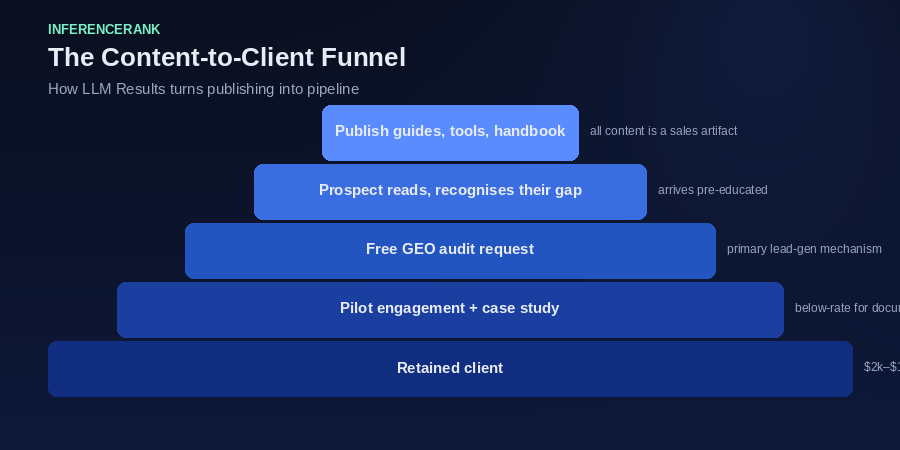
SEO clients come pre-educated — they know they want to rank higher, they understand the concept, and they have mental benchmarks for what an agency should cost. GEO clients don't yet. Most of the brands that need GEO most urgently haven't heard the term, don't have a budget line for it, and need to be shown the problem before they'll pay to fix it. That means the first step in every sales conversation is education, not proposal. The content on this site exists partly to skip that step: a prospect who arrived via a guide or tool already knows what GEO is and why it matters. They just need to decide whether to do it themselves or hire us.
Where the first clients actually come from
The realistic channels for a new GEO consultancy are: the warm network (people who already know and trust you, who are willing to be early adopters of a new service category), content-driven inbound (someone read a guide, used a tool, recognized their own situation in what they read, and reached out), and the free audit as a door opener. Cold outreach without a content proof-point is noise; cold outreach after someone has already read five of your guides is a warm follow-up. The sequence matters.
Niche positioning accelerates this. A GEO consultancy that works with any industry at any scale competes with every SEO agency that has added "GEO" to their services page. A consultancy that specifically helps B2B SaaS companies appear in the AI answers their buyers consult is a different conversation entirely — and a much shorter one.
The free GEO audit is the primary lead-gen mechanism here. It's low-commitment for the prospect, demonstrates the methodology directly, and produces a deliverable — a citation gap report — that makes the problem concrete. A prospect who sees their own citation gaps laid out in a report is now looking at a problem with a price tag, not an abstract concept. The conversion rate from audit to paid engagement is far higher than from any other first touchpoint.
What the audit deliverable actually contains
A GEO audit runs 20–30 target buyer prompts across ChatGPT, Perplexity, Claude, Gemini, and Google AI Overviews. For each prompt, we record: which sources get cited, whether the client appears, what competitors appear in their place, and what the AI says about the client when it does mention them. From that we build a citation gap map — by query type, by engine, by competitor — and a prioritized list of content fixes ordered by expected citation impact. The deliverable is typically a structured report with a prompt log, gap analysis, and a 90-day action plan. It takes roughly four to six hours to produce well.
How we priced early engagements
The first client is more valuable as a case study than at full rate. The math on this is straightforward: a documented result — "Client X went from zero AI citations on their target category queries to being cited in 70% of responses within 90 days" — is worth more in future sales than the margin on a discounted first engagement. Early clients should understand they're getting a pilot rate in exchange for documented, publishable results. The services page lists the current standard rates; early engagements were meaningfully below those while the case study portfolio was still thin.
What ideal early clients look like
The clients where GEO delivers fast, visible results share a few traits: they already rank reasonably well organically but don't appear in AI answers, which means the content quality is there but the extractability isn't; they're technically capable of implementing recommendations without handholding; and they're in a category where buyers actually use AI for research — software, professional services, financial tools, health information, and similar. Clients in categories where buyers still mostly use search or referrals are harder to show results for, not because the work doesn't apply but because the measurement is slower.
What we'd do differently
Start the audit deliverable template earlier. The first few audits were bespoke documents that took longer than they should have and were harder to repeat. A structured template — consistent sections, consistent prompt log format, consistent gap analysis — makes the work faster and makes the deliverable more professional. The template is now the artifact; the analysis fills it in. The other thing: qualify the category earlier. Not every prospect who understands GEO is in a category where AI citations currently drive meaningful buyer behavior. Those conversations are educational exercises, not near-term pipeline.