Why publish the mistakes?
Because they're the most valuable part. Anyone can infer the wins from a finished site; the errors and dead ends are the expensive knowledge, and sharing them is the whole point of building in the open. It also keeps us honest — knowing a mistake will be written down makes us likelier to actually fix it.
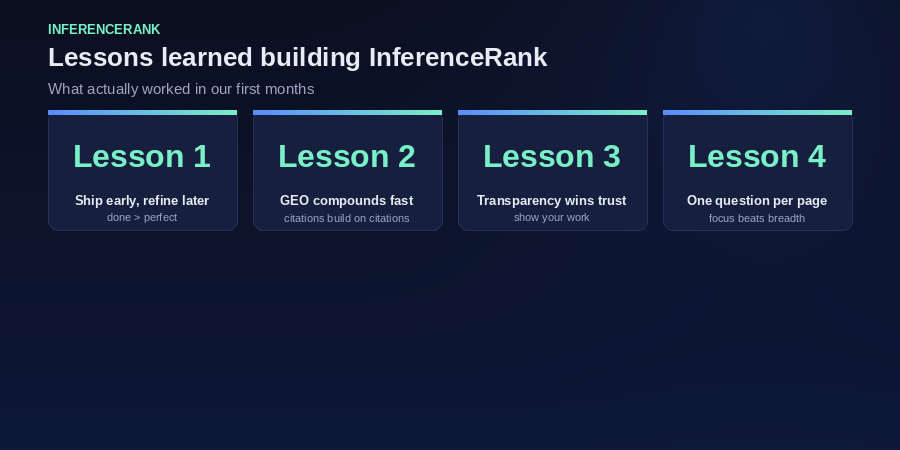
Every week we wait to publish is a week without citations and without reader feedback. A page that's 80% ready and live beats a perfect page that's still in draft.
What's working so far
Building the system before the audience paid off: a small, dependency-free build that generates the SEO head, structured data, and discovery files means publishing is cheap and consistent, which is what lets content compound. Writing the two tracks together — guides that teach and a handbook that documents — has also been mutually reinforcing, since each gives the other something to link to.
What we'd do differently
We spent real effort polishing the machinery early — satisfying, and genuinely useful, but a reminder that infrastructure is the easy, comfortable work and distribution is the hard, uncomfortable work that actually grows a business. If we were starting again we'd timebox the build sooner and force ourselves into the outreach earlier, because no amount of clever tooling substitutes for someone deciding to talk to people.
The honest unknowns
Much of the plan is still unproven. We haven't yet shown that the content compounds into meaningful share-of-answer, that citations convert to paying clients at a workable rate, or that the open-handbook approach actually distributes. Those are hypotheses, and this chapter will record how they turn out — including if some are wrong. Documenting uncertainty as uncertainty is part of not deceiving anyone, including ourselves.
How this chapter evolves
It's deliberately unfinished. As we get real data — on traffic, conversions, what distribution channels work — we'll add lessons and revise earlier ones, dating the changes. Treat it as the most live page in the handbook: the place where reality edits the plan.
The short version
What's working: build-first publishing and two reinforcing tracks. What we'd change: polish less, distribute sooner. What's unknown: whether the whole flywheel pays. We'll keep writing it down as we find out.