What is agentic search?
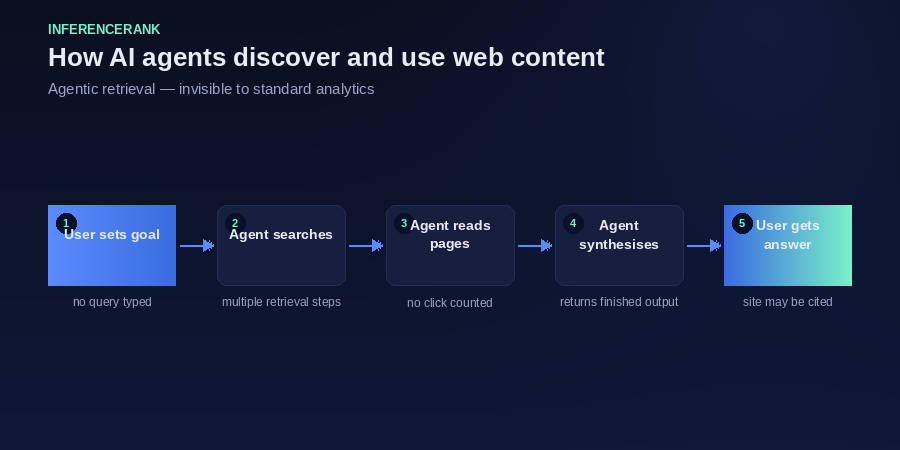
Agentic search refers to AI systems that retrieve and consume web content as part of completing a multi-step task — rather than in response to a single user query. A user might instruct an agent to "research three vendors, compare pricing, and draft a recommendation." The agent then conducts multiple searches, reads pages, follows links, synthesizes findings, and returns a finished output. The human never typed a search query; the agent did everything in the background.
This is structurally different from AI search engines like Perplexity or Google AI Overviews, which still respond to a single explicit query. Agents run persistent, goal-directed sessions. Google's AI Mode, which passed 1 billion monthly users in its first year, now includes "information agents" that operate 24/7 in the background — monitoring news, tracking changes, and pushing updates to users without new queries being issued.
How large is the agentic AI market in 2026?
The global AI agent market reached $7.84 billion in 2025 and is projected to hit $52.62 billion by 2030, according to market research compiled by AIM Multiple. Gartner estimates that 40% of enterprise applications will include task-specific AI agents by the end of 2026. At the consumer level, Google's Mariner, OpenAI's Operator, and Anthropic's Claude agents are all capable of browsing the web and interacting with content on users' behalf.
How do agents discover and read web content?
Agents rely on the same infrastructure as traditional crawlers — sitemaps, robots.txt, and indexed content — but they consume it differently. Where a search engine builds an index and returns ranked links, an agent reads the actual page and reasons over its contents. A page that ranks well but is structured for skimming (scattered key points, long preamble, no clear machine-readable structure) may be retrieved but poorly understood. Pages that state their main claim upfront, use clear headers, and provide specific sourced data give agents something to extract and act on.
Microsoft's NLWeb protocol, announced in 2026, takes this further. NLWeb lets any website expose a natural language API endpoint so agents can query it directly — "what are your pricing tiers?" — rather than scraping a human-readable page. Every NLWeb endpoint also acts as an MCP (Model Context Protocol) server, the emerging standard for how AI agents communicate with tools and data sources. Time magazine has already adopted NLWeb. The protocol is designed to become for agents what HTML was for browsers.
Unlike search engine bots, many AI agents don't announce themselves with a recognizable user-agent string. Some use headless browsers; others scrape via APIs. Standard web analytics significantly undercounts agentic traffic because it's attributed to "direct" or classified as bot traffic and filtered out. Your actual agent audience may already be larger than your metrics show.
What do agents look for in content?
Agents are optimizing for task completion, not engagement. They want specific, actionable, verifiable information — prices, specifications, procedures, comparisons, named sources. Hedged, generic, or padded content is not useful to an agent and gets skipped in favor of a source that gives a direct answer. This converges with what AI search engines reward: concise, quotable, specific prose that makes a clear claim and backs it with evidence.
Structured data accelerates agent comprehension. An agent parsing a page with clear schema markup — Product, FAQPage, HowTo, Article — can extract structured facts without parsing prose. Sites that invested in structured data for SEO are inadvertently already optimized for agents.
What does this mean for agentic discoverability?
The emerging discipline is sometimes called Agent Experience Optimization (AXO). It builds on the same foundations as GEO but extends them: allow known AI user-agents in robots.txt, maintain a current sitemap and RSS feed so agents can discover new content quickly, implement schema markup, and structure pages so the key answer appears in the first 200 words. For publishers looking ahead, NLWeb and MCP integration represent the next frontier — making content natively queryable by agents rather than passively crawlable.
Will agent traffic replace search traffic?
Not replace — supplement, and then possibly surpass for some categories. The referral traffic data that does exist is encouraging: ChatGPT referrals convert at around 16% and Claude referrals at 16.8%, compared to 1.76% for traditional Google organic traffic, according to 2026 benchmarks. Agentic visitors arrive already informed, with a specific task in mind, which makes them more likely to convert. The challenge is that this traffic is currently invisible in standard analytics, which means most publishers don't yet know how dependent they've become on it.