The query is getting longer and more specific
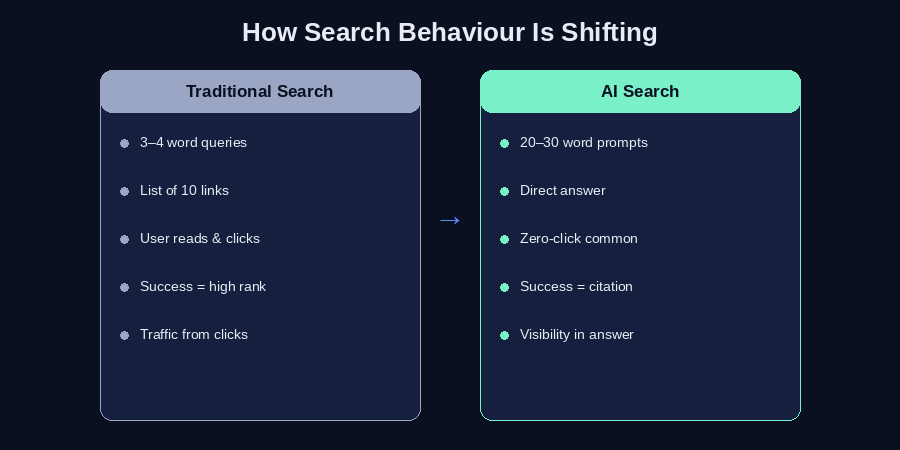
Traditional search queries average three to four words. Prompts entered into AI assistants routinely run to twenty or thirty words — full sentences, context, follow-up conditions. "Best running shoes" becomes "what are the best running shoes for someone with plantar fasciitis who runs on pavement and doesn't want to spend more than $150." The content that answers the first query is largely useless for the second. Publishers optimizing purely for short head terms are increasingly invisible to this new class of searcher.
Users expect the answer, not a list
A decade of Google's featured snippets trained users to expect at least a partial answer at the top of the results page. AI answers have accelerated that expectation dramatically — users now expect a complete, personalized response that doesn't require opening five tabs and synthesizing them manually. For genuinely informational queries (how does X work, what's the difference between X and Y, should I do X), a significant and growing share of users get their answer entirely within the AI interface and never visit a source page. This is sometimes called "zero-click" behaviour, though a more accurate term is answer-terminal — the AI is the final destination.
Organic click volume for informational queries is declining even when rankings hold. Publishers who relied on informational content for top-of-funnel traffic are seeing that traffic erode regardless of their SEO performance. The channel is changing, not just the competition within it.
Research-heavy decisions are shifting to AI first
High-consideration purchases — B2B software, financial services, healthcare decisions, professional services — involve significant research phases. Buyers used to conduct that research via Google and trade publications. Increasingly, the research phase begins with an AI assistant: asking it to compare options, explain tradeoffs, flag risks, suggest questions to ask vendors. The implications are significant for B2B marketers in particular: you're no longer just competing for a Google ranking on your category keyword — you're competing for the passage that a model cites when a prospective buyer asks an AI assistant about your space.
Brand queries are happening inside AI
Users are asking AI assistants about specific companies — "what do people think of Acme Software", "is Acme Software good for enterprise", "Acme Software vs Contoso, what are the differences." These branded queries have historically shown up as direct or brand search traffic, which publishers could measure. Brand queries inside AI assistants produce no referral traffic at all if the user accepts the AI's answer as sufficient. How a brand is characterized in those AI responses depends almost entirely on what the web says about it in indexed, crawlable content — which means brand reputation management and GEO are now the same function.
Not all traffic is declining equally
Transactional queries — where someone needs to actually complete an action (book a table, buy a product, sign up for a trial) — still generate clicks, because AI can't complete the transaction for the user. Opinion and experience queries ("I tried X, here's what happened") also still generate clicks, because users want to read primary accounts. Deep technical documentation, tool-specific guides, and content where the detail is the point also hold up well. What's eroding is generic informational content — overviews, explainers, "what is X" posts — that AI can answer directly from its training data or a quick retrieval pass.
The shift is accelerating, not levelling off
AI capabilities are improving, model context windows are growing, and retrieval quality is getting better. Each improvement increases the proportion of queries AI can answer satisfactorily without the user needing to visit a source. The publishers who are adapting now — building GEO-ready content that positions them as the source AI cites rather than a page a user clicks to — are building a durable advantage over those still optimizing purely for a click-through model that is structurally declining.
The short version
Search behaviour is shifting from keyword queries to conversational questions, from link-scanning to answer-reading, and from click-through to answer-terminal. Traffic for pure informational content is eroding. Being cited inside the answer — not just ranked below it — is increasingly where organic visibility lives.