Why the transition isn't starting over
AI answer engines — ChatGPT, Claude, Perplexity, Google AI Overviews — still depend on crawled web content. They don't bypass the fundamentals of technical SEO; they assume them. A page that can't be crawled, loads slowly, or has thin content won't be retrieved any more than it would rank. Your existing investment in indexable, fast, authoritative pages is the prerequisite for GEO, not baggage from a different era.
SEO asks: "Will this page rank for this query?" GEO asks: "Will a model quote this passage to answer this question?" The unit of success changes from position to citation, but the underlying quality signals are largely the same.
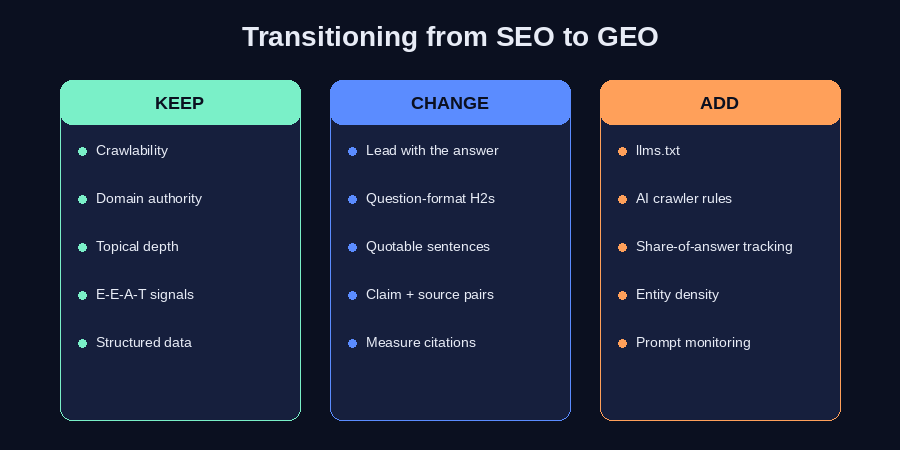
What carries over from SEO
The following SEO work transfers directly to GEO with no changes required:
- Technical crawlability. Clean robots.txt, correct canonicals, fast load times, and no JavaScript walls around content all remain table stakes. AI crawlers behave like well-behaved Googlebots — they need clear access and complete HTML.
- Domain authority and backlinks. Models are trained on content weighted by quality signals, and retrieval systems still favor authoritative sources. A strong link profile helps.
- Topical depth. Comprehensive, well-researched content on a narrow topic clusters better in retrieval systems than thin pages trying to cover everything. Your content silos are assets.
- E-E-A-T signals. Author credentials, named sources, about pages, and contact information all contribute to trustworthiness — and models are sensitive to exactly these signals when deciding whether to cite a source.
- Structured data. Schema.org markup you added for Google's rich results is read by AI systems too. Keep it and expand it.
What changes in GEO
Several things you optimized for in SEO stop mattering, and some things that barely mattered start mattering a great deal.
- Keyword density → direct answers. GEO rewards pages that state the answer in the first paragraph, not pages that repeat a keyword phrase several times. Lead with the answer, then explain it.
- Click-through rate → quotability. You can't A/B test meta descriptions for CTR in an AI response. The equivalent question is whether your prose is clean enough to lift out of context and quote verbatim. Short, declarative sentences beat fluent but winding ones.
- Position 1 → best-passage match. A page ranked fifth can be the top citation if it contains the clearest passage answering the question. Heading structure, paragraph granularity, and specificity matter more than domain-level authority in passage retrieval.
- Traffic as the primary metric → share of answer. Ranking reports stop telling the full story. You need to track how often your brand appears in AI responses for your target queries. This requires prompt-based monitoring, not just a rank tracker.
What's genuinely new in GEO
A few things have no SEO equivalent at all:
- Answer-first page structure. Traditional SEO content often builds toward the conclusion. GEO inverts this: the answer goes in the first paragraph, and the rest of the page is supporting detail. Models retrieve the top of the page first and quote what they find there.
- llms.txt. A plain-text file at
/llms.txtthat summarizes your site for language models — similar in spirit to sitemap.xml but designed for AI reading rather than crawler indexing. Google doesn't care about it; the AI engines increasingly do. - AI crawler allowlisting. GPTBot, ClaudeBot, and PerplexityBot are blocked by many robots.txt files by default or by blanket disallow rules. Explicitly welcoming them is a zero-effort GEO win that most sites haven't made yet.
- Entity and claim density. SEO rewards readability and reasonable length. GEO also rewards density: pages that pack verifiable facts, named entities, and specific figures into tight prose give models more to work with and cite.
The practical transition checklist
If you're moving an existing site from SEO-only to SEO + GEO, work through these in order:
- Audit your robots.txt and explicitly allow GPTBot, ClaudeBot, PerplexityBot, Google-Extended, and CCBot.
- Add an llms.txt file at your domain root summarizing your site's sections and key pages.
- Rewrite your top-performing SEO pages so the first paragraph answers the question directly and stands alone if quoted.
- Restructure H2 headings as the questions your audience actually asks, with tight answers in the paragraph below each one.
- Add specifics: named figures, sources, dates. Replace "many studies show" with a named study and a number.
- Expand your schema.org coverage: Article, FAQPage, and HowTo schema all get read by AI retrieval systems.
- Set up prompt-based monitoring: run your target queries in ChatGPT, Perplexity, and Claude each week and track whether your brand is named.
Do you need to choose between SEO and GEO?
No. GEO is additive at the content and technical level — the work you do for one reinforces the other. The only place they genuinely diverge is measurement: SEO is measured by rank and organic traffic, GEO by citation frequency and share of answer. Run both reports. Over time, the balance of where your traffic comes from will shift; staying visible in both channels means you don't lose ground as that shift happens.
The short version
Keep everything that makes your site technically clean and authoritative. Restructure content to lead with the answer, use question-format headings, and pack in verifiable specifics. Add llms.txt and open your robots.txt to AI crawlers. Then measure both rank and citation — they'll start telling different stories, and you want to be doing well in both.