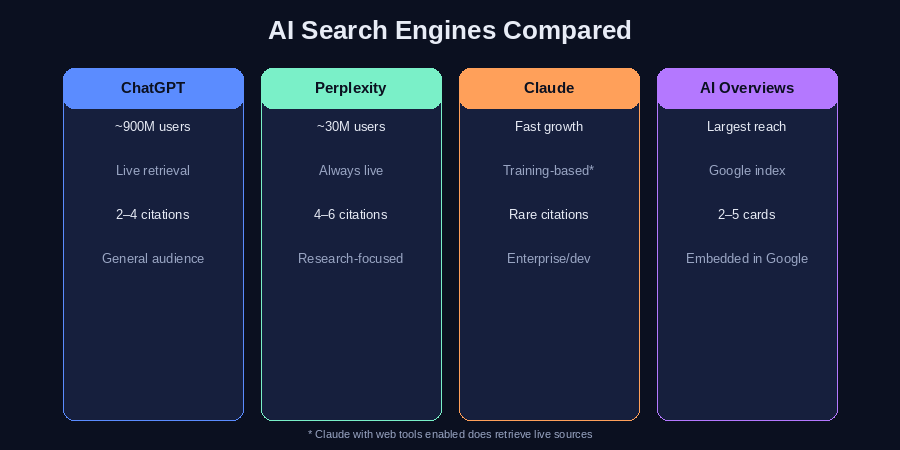
The engines that matter most
As of mid-2026, five AI systems account for the majority of AI-assisted information queries: ChatGPT (OpenAI), Google Gemini, Perplexity AI, Claude (Anthropic), and Google AI Overviews. ChatGPT holds 54.7% of worldwide AI-chat visits across the major platforms; Gemini has grown from 5.6% share in early 2025 to 27.4% by April 2026, reaching 900 million monthly users through the Gemini app alone — and 2.5 billion through AI Overviews embedded in Google Search. Perplexity grew 370% year-over-year, and Claude grew 190% with the fastest quarterly growth rate (14%) of any major provider. Each rewards somewhat different content strategies; treating them as interchangeable is a mistake.
ChatGPT (OpenAI)
ChatGPT is the highest-volume AI assistant by user count. Without web search enabled, it answers from its training data, which means recently published content won't be cited. With web search enabled (the default in the paid tiers), it runs live Bing-backed retrieval and cites sources inline. The citation format is footnote-style links embedded in the response. ChatGPT's user base is broad and general — consumer, business, student — which means high traffic potential but diffuse query intent. The model tends to prefer authoritative, well-structured prose and cites fewer sources per answer than Perplexity.
Perplexity AI
Perplexity is purpose-built for search — every query triggers live web retrieval, and the interface is explicitly designed around cited answers. It typically returns four to six source citations displayed prominently alongside the response. Users skew toward research-oriented and technically sophisticated audiences. Perplexity is the engine where citation volume is highest and where appearing as a named source has the most direct visibility benefit. It also offers Spaces (topic-specific assistants) and is growing in enterprise use. For content aimed at informed buyers doing due diligence, Perplexity is often the highest-priority engine to optimize for.
If your buyers are researchers, analysts, or technically sophisticated: Perplexity first. If you're optimizing for general consumer reach: ChatGPT with web search. If you sell to businesses that rely on Google: AI Overviews. For a thoughtful audience that values nuance: Claude.
Claude (Anthropic)
Claude is primarily used as a productivity and reasoning assistant rather than a search interface. Without operator-configured tool use, it answers from training data and doesn't retrieve live web content — which means it can't be "optimized for" in the same real-time way. However, Claude is used heavily in agentic and automated workflows (it can be given web access by developers building on the API), and it surfaces in enterprise environments through Amazon Bedrock and Google Cloud. The audience tends to be knowledge workers — writers, analysts, developers — who ask nuanced questions expecting nuanced answers. Brand presence in Claude's training data (through high-quality, widely cited content) matters more here than technical crawler access.
Google AI Overviews
Google AI Overviews (formerly Search Generative Experience) sits at the top of Google Search results pages. It has by far the largest potential reach of any AI engine, given Google's search volume, but appears selectively — primarily for informational queries where Google judges a synthesized answer more useful than a list of links. It draws on Google's own index and ranking infrastructure, so traditional SEO signals (domain authority, page speed, E-E-A-T) matter significantly here. Citations appear as inline cards linking to the sourced pages. Because AI Overviews is embedded in the existing Google results page, it affects click-through rates for ranked pages — appearing in the overview means users may get the answer without clicking through.
How they compare on citation behaviour
| Engine | Live retrieval | Citations shown | Typical sources cited |
|---|---|---|---|
| ChatGPT (web search on) | Yes | Inline footnotes | 2–4 per answer |
| Perplexity AI | Always | Numbered inline + sidebar | 4–6 per answer |
| Claude (default) | No | Rarely (training only) | 0–1 per answer |
| Google AI Overviews | Yes (Google index) | Cards with page snippets | 2–5 per overview |
The short version
Perplexity is the most citation-transparent engine and the best signal of whether your content is working. ChatGPT and Google AI Overviews reach the most users. Claude is the hardest to optimize for in real time but matters in enterprise and automated workflows. A solid GEO strategy treats each differently rather than assuming one content approach serves all four.