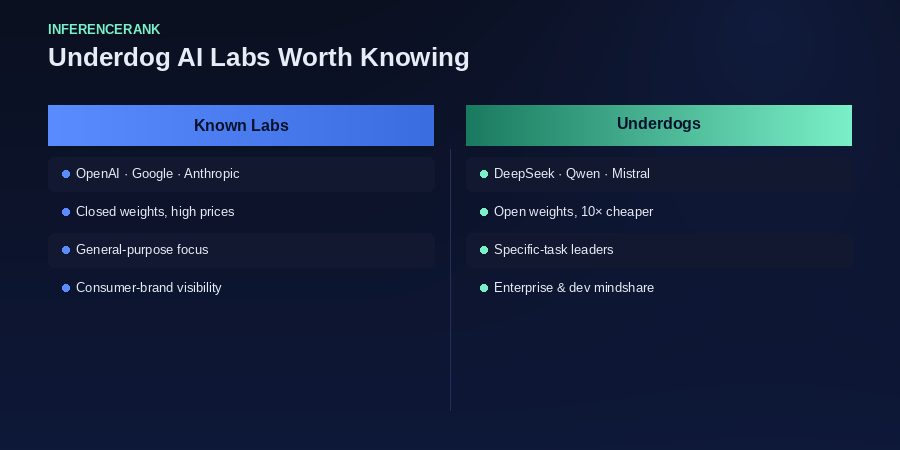
Why watch the underdogs at all?
Eighteen months ago, the gap between frontier labs and everyone else was wide enough to ignore. That's no longer true. DeepSeek's January 2026 release rattled markets so hard that Nvidia lost $600 billion in market cap in five days — Marc Andreessen called it "AI's Sputnik moment." Alibaba's Qwen 3.6 beat Gemma 4 on every coding benchmark in April 2026. Mistral's Small 4 unified reasoning, vision, and coding into a single open-weight model that runs cheaply. The capability gap from the closed-source frontier is real but smaller than it was, and for specific workloads, some underdogs now lead outright.
DeepSeek: cost disruption from China
DeepSeek is a Chinese AI lab that had barely registered in Western tech circles before it released DeepSeek V3 in late 2025 and the reasoning-focused R1 shortly after. Both are open-weight. API pricing runs roughly 10× cheaper than equivalent Western models. R1's extended chain-of-thought reasoning puts it competitive with GPT-4-class models on math and coding benchmarks at a fraction of the cost. The April 2026 follow-up, DeepSeek V4 (released as V4-Pro and V4-Flash), extended the lead on cost-sensitive production workloads. For teams running high-volume inference where budget matters, DeepSeek is the first name on the shortlist.
Alibaba's Qwen: the busiest lab in 2026
Alibaba's Qwen family had the highest release cadence of any lab in early 2026. Qwen 3.6-72B achieved 94.8% on HumanEval, 68.2% on SWE-bench Verified, and 71.4% on LiveCodeBench — beating Gemma 4 on every coding benchmark in April 2026. The GPQA Diamond score of 88.4% puts it competitive with GPT-5.5 on scientific reasoning. The architecture is a hybrid Gated DeltaNet and Mixture-of-Experts design that delivers 8–19× faster decoding than its predecessor at 60% lower compute cost. Qwen is open-weight, which means you can run it yourself or fine-tune it. For coding and technical reasoning at scale, it's now the go-to open alternative.
Mistral: Europe's open-weight champion
Mistral AI is a Paris-based lab that punches well above its headcount. The Mistral family covers text, code (Devstral), and vision (Pixtral), and the March 2026 Mistral Small 4 — a 128-expert Mixture-of-Experts model — unified reasoning, multimodal, and coding capabilities into a single open-weight model with configurable reasoning effort. For European organizations with data-residency requirements, Mistral is often the only viable frontier-class option: the models are EU-hosted, GDPR-compliant by design, and the open weights mean full on-premise deployment is possible. Mistral Large scored 7.8 on general benchmarks at significantly lower inference cost than comparable closed models.
xAI and Grok: the real-time advantage
Elon Musk's xAI lab ships Grok, which has a structural advantage no other model can replicate: native access to the full X (formerly Twitter) data feed in real time. For use cases involving breaking news, market sentiment, public figures, or anything where recency matters more than depth, Grok 4 is the practical choice. Grok 4.1 Fast extends this with a 2-million-token context window — eliminating chunking for long-document analysis. In May 2026, xAI released Grok Build 0.1, an early-access coding model specifically trained for agentic software engineering. Grok 3 was promised as open-weight but remained proprietary as of mid-2026.
Cohere: enterprise RAG and data residency
Cohere doesn't compete for consumer headlines. It competes for enterprise contracts — and wins them. The Command R series is built specifically for retrieval-augmented generation (RAG) and tool use, with strong citation support and the commercial guarantees large organizations need: contractual data handling, US/EU/Canada data residency, and Apache 2.0 licensing on Command A+. The May 2026 Command A+ is the current flagship, optimized for agentic workflows and multilingual applications. For enterprises that can't send data to OpenAI or Google's infrastructure and need a model that understands enterprise search patterns natively, Cohere is often the answer.
Reka: multimodal from the ground up
Reka AI was founded by researchers who left DeepMind, and it shows in the architecture. Where most labs treat multimodality as an add-on to a text model, Reka built for audio, video, and image understanding from the start. The lab is less consumer-visible than the others on this list but produces capable models for applications that genuinely need to reason across media types — a domain where the headline labs still have uneven track records. Reka is worth watching as video-native AI applications mature.
The underdogs listed here aren't beating GPT-5 or Gemini 3 Ultra at general intelligence tasks. What they're doing is closing the gap on specific workloads — coding, RAG, real-time data, cost-per-token — and making it harder to justify paying frontier prices for tasks that don't need frontier capability. The practical implication: know what your workload actually requires before defaulting to the most famous name.
What to watch next
The architecture story is moving fast too. SubQ shipped the first commercial subquadratic LLM with a 12-million-token context in 2026, and Zyphra released an 8B Mixture-of-Experts model claiming frontier-adjacent reasoning at 760 million active parameters on AMD silicon. Neither is production-proven at scale yet, but they signal where the next round of cost disruption will come from: not just smaller models, but fundamentally different architectures that don't scale the same way transformers do.