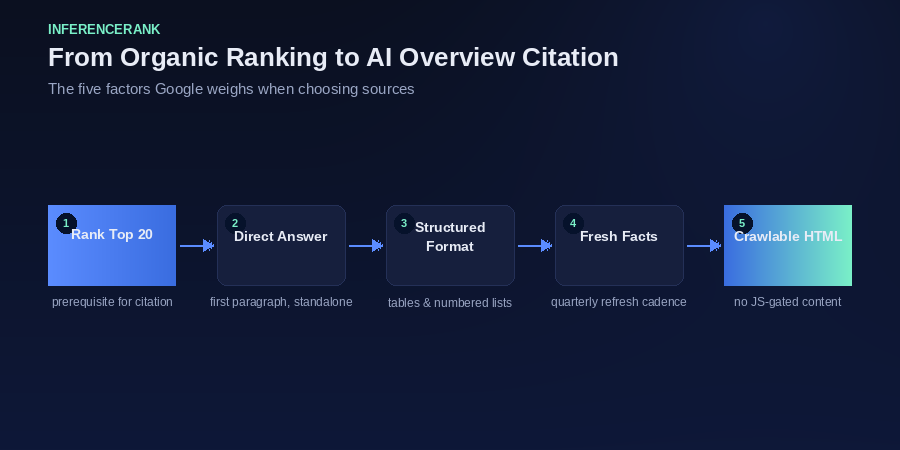
What is Google AI Overviews, and how does it choose sources?
AI Overviews is Google's AI-generated summary that appears above organic results for many queries. It retrieves candidate pages from the indexed web, synthesizes an answer, and often names the sources it leaned on. Studies consistently show that 94–97% of AI Overview citations come from pages already in the organic top 20 for that query. Rank first, and you're in the pool. Don't rank, and you're not being considered at all — regardless of your content quality.
That said, this share is shifting. In 2026, Google increasingly cites lower-ranking pages when those pages contain clearer, more extractable answers. Ranking is necessary but no longer sufficient.
Does AI Overviews need special optimization?
Google's official position is no. Neither special schema markup, an llms.txt file, content chunking, nor AI-specific rewrites are required for AI Overviews. Google's guidance explicitly states that optimizing for its generative AI features is "still SEO" — the same fundamentals that earn organic rankings also determine AIO eligibility. What changes is the emphasis: answer extractability matters far more here than it does for a blue-link result.
Two pages can have the same ranking and the same content depth. The one with a direct answer in the first paragraph, question-phrased headings, and a data table gets cited. The one with a long wind-up and prose-only structure doesn't. That gap is entirely within your control.
What content formats does AI Overviews prefer?
Structured formats appear in AI Overviews far more often than prose-only content. HTML tables with proper headers get pulled when answers involve comparisons or specifications. Numbered lists appear when the answer is a sequence or process. A page that mixes a direct opening paragraph with a relevant table and a numbered summary gives Google three extractable elements to work with instead of one. Don't structure for aesthetics; structure for extractability.
How much does content freshness matter?
Significantly. Google actively weights recency, and stale statistics or outdated examples reduce the likelihood a page gets cited even if it ranks well. A practical cadence: review AIO-priority pages quarterly, update any statistics that have changed, re-date the page with a visible dateModified, and republish. Search Console's generative AI performance reports — rolled out in June 2026 — now let you track which queries trigger AI Overviews and whether your pages are cited, so you can target your refresh effort precisely.
What technical factors block AI Overview inclusion?
Googlebot must be able to crawl and fully index your page. Three things commonly block this: disallowing Googlebot in robots.txt (or blocking it accidentally while trying to block other bots), loading substantive content only via client-side JavaScript that delays indexing, and using lazy-load patterns that hide content below the fold from the crawler. Check Search Console's URL inspection tool for any specific pages you expect to appear in AI Overviews — if Googlebot can't see the answer, neither can the AI.
Does entity coverage affect AI Overview citations?
Yes, though it's harder to measure directly. When a page consistently names the relevant entities in a topic — the tools, standards, companies, and concepts, and how they relate — it builds a clearer signal about what the page is authoritative on. A consistent entity profile across your site, combined with mentions in relevant third-party sources, increases the probability that Google associates your brand with the topic rather than a competitor who covers the same ground.
The short version
Rank in the top 20, lead with a direct answer, use tables and numbered lists where the content calls for it, refresh statistics quarterly, and keep your pages crawlable. That's the full checklist. There's no AI-specific trick on top of it.