How widespread are AI Overviews in 2026?
As of March 2026, Google AI Overviews appear on 48% of all search queries — up from 13% just twelve months earlier. That growth rate is faster than any previous SERP feature rollout. The expansion has been heaviest on informational and educational queries, where AI Overviews now appear in the majority of searches. Commercial and transactional queries are increasingly affected too, as Google tests formats that blend product carousels with generated summaries.
What do AI Overviews do to click-through rates?
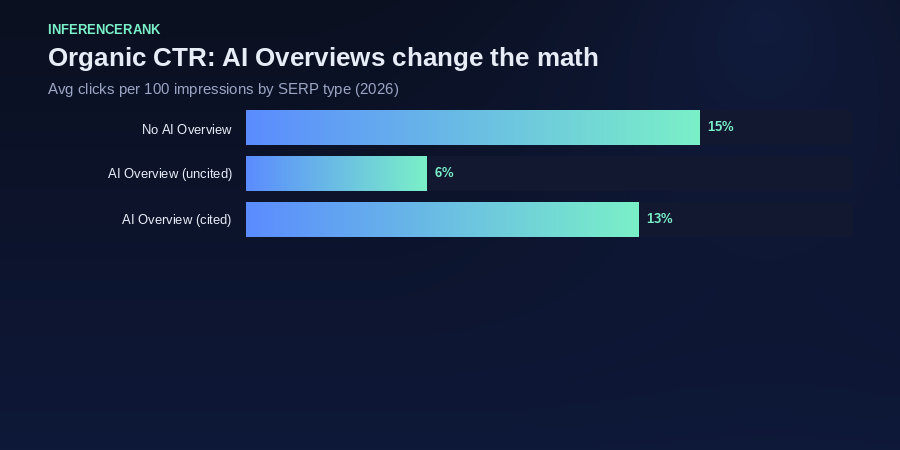
The data is consistent across multiple independent studies. Ahrefs measured a 58% reduction in CTR on the top-ranking page for queries where an AI Overview appeared, using February 2026 data. Pew Research found that queries with an AI Overview generate an 8% click rate, compared to 15% without one — roughly half. Depending on query type and methodology, the measured drop ranges from 34% to 61%.
The mechanism is straightforward: when Google answers the question in the SERP itself, users don't need to click anywhere to get their answer. For navigational or purchase-intent queries, this effect is less severe. For informational queries — "what is X," "how does Y work," "best Z for…" — it's most damaging.
When no AI Overview is present, about 40% of Google searches end without a click. When an AI Overview is present, that figure rises to 80–83%. For informational queries, ranking #1 no longer guarantees meaningful traffic if the answer is surfaced above your result.
Does being cited in an AI Overview help?
Significantly, yes. Seer Interactive's 2026 analysis found that brands cited in AI Overviews earn approximately 120% more organic clicks per impression than uncited brands on the same queries. A separate measure from Authority Tech puts the cited CTR advantage at 35% higher organic clicks, plus 91% higher paid CTR compared to uncited competitors. The position of your listing also predicts citation probability: a page ranking #1 has a 58% chance of being cited; by position 10, that drops to 14%.
The quality of that traffic also differs. AI-referred visitors — those who clicked through from a citation — convert 42% better, spend 48% longer on site, and generate 37% higher revenue per visit compared to traditional organic visitors, according to data compiled by The Digital Bloom in 2026. The implication: losing raw traffic volume to AI Overviews hurts, but earning citation recovers more of the economic value than the headline CTR numbers suggest.
Which query types are most affected?
Informational queries with clear factual answers are most vulnerable — these are exactly the queries where Google can synthesize a complete answer from existing content. "How to" queries, definition queries, and comparison queries all show high AI Overview rates. Local service queries ("dentist near me," "plumber in [city]") show lower AI Overview penetration but are growing. Product and transactional queries currently show lower impact, though Google's Q1 2026 experiments with shopping-integrated AI Overviews suggest that will change.
How is Google monetizing AI Overviews?
Ad placements alongside AI Overviews surged from 5.17% of AI Overview SERPs in early 2025 to 25.5% in Q1 2026. Google is structurally substituting organic results with a format that it can monetize — AI Overviews push organic results further down while keeping ads adjacent to the generated answer. For publishers relying on organic search traffic and display advertising, this is a compounding pressure: fewer clicks through, and more ad inventory captured by Google itself.
What does this mean for content strategy?
The practical shift is from ranking optimization to citation optimization. Ranking #1 for a query where an AI Overview exists is worth far less than it was in 2023. Being cited inside the AI Overview — even if your organic result sits at position 3 or 4 — recovers a meaningful share of the traffic and delivers higher-quality visitors. Citation probability correlates with answer-first structure, specific sourced claims, and crawlability for Google's indexing bots. Content designed to be quoted rather than merely ranked is the durable adaptation.