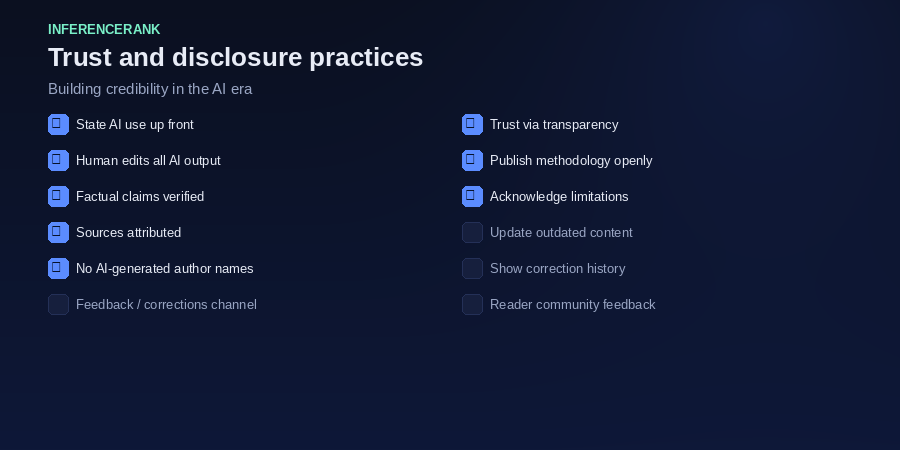
Why does a GEO company need a trust policy?
We ask clients to trust us with their visibility and readers to trust our guidance, and we publish a handbook inviting people to copy us. That only works if we're visibly honest. Writing the rules down makes them real and keeps us consistent when a shortcut is tempting — the policy is a precommitment, not a press release.
We apply the same GEO-citation standard to ourselves that we recommend to clients: every claim attributed, every AI use disclosed, every fact checked before publish.
What do we disclose?
Anything that would change how you read a page. Ads are clearly labeled as advertising. When content is produced with AI assistance, we don't pretend otherwise. If we ever earn from recommending a tool, that relationship gets disclosed at the point of recommendation. The test is simple: if knowing it would change your trust in the page, you should be told.
How do we handle client confidentiality?
Client work is private by default. We turn an engagement into a public case study only with explicit permission, and we let the client decide how much is named. The open handbook documents our own operation and methods, not our clients' — transparency about ourselves never comes at a client's expense.
What claims will — and won't — we make?
We won't guarantee a specific citation, ranking, or that any named engine will mention you by a date, because no honest practitioner controls a model's output. We will commit to method, effort, and measurement, and we'll show real share-of-answer movement. Promising certainty we can't deliver would win a deal and lose the trust that the whole business runs on.
What's our ad policy?
Ads serve humans, full stop. They're clean, labeled, and placed so they don't wreck the reading experience, and we never attempt to monetize bot or crawler traffic — it doesn't pay, it defrauds advertisers, and it would contradict everything else here. If a format ever costs us more in credibility than it earns, it comes down. The reasoning is in monetization.
How do we handle data?
We collect as little as we need. The contact form asks for what's required to have a useful first conversation and nothing more, and we don't sell or share what people send us. Minimal collection is both the respectful default and one less thing that can go wrong.
The short version
Disclose what matters, keep client work private, promise method not miracles, and run human-only ads. The rules exist because trust is the asset — lose it once and the open-company premise collapses.