What is agentic search?
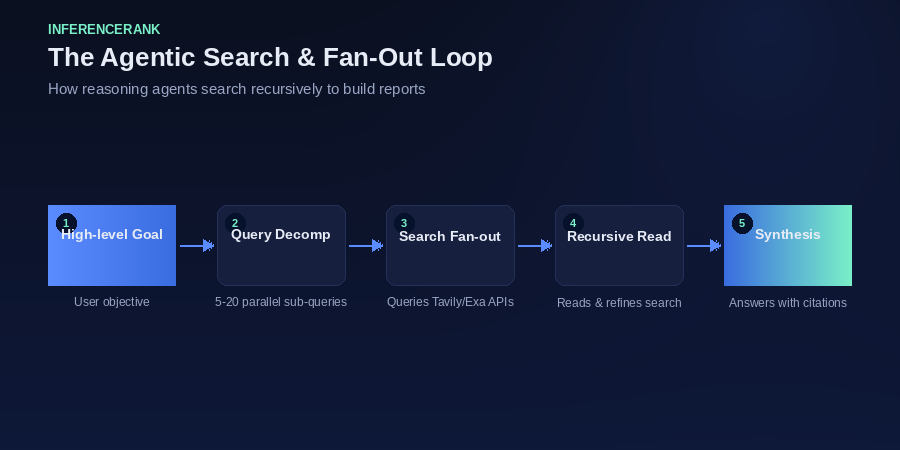
Traditional search and basic RAG are single-turn: you type a prompt, the engine performs one query lookup, reads a few snippets, and generates an answer. Agentic search is different. It uses autonomous loops. When given a complex goal—such as "Compile a table of the top four GEO agencies, their pricing, and customer reviews"—the agent doesn't just do one search. It writes a multi-step plan, searches the web, analyzes the retrieved text, and uses its findings to generate further search queries to fill in missing gaps.
What is query fan-out?
Query fan-out is a key technique used by these autonomous agents. Instead of running search queries one by one, the agent analyzes the high-level request and "fans out" five, ten, or even twenty distinct sub-queries in parallel. For example, a request for agency comparisons is decomposed into: "Agency A pricing", "Agency B services", "Agency C reviews", and "Generative Engine Optimization market standards." This parallel exploration allows the agent to gather a broad foundation of data instantly.
In the agentic era, optimizing for a single head keyword is useless. Agents are querying the web for specific, granular entities and facts. If your site doesn't explicitly state details like pricing, service limits, or founder names, the agent's targeted sub-queries will bypass your page entirely and cite a competitor who publishes them.
The recursive refinement loop
Once the initial fanned-out queries return results, the agent enters a recursive refinement loop. It parses the retrieved pages, extracts entities, and cross-references facts. If it finds conflicting information—or realizes it lacks data on a specific sub-point—it automatically generates and executes a second layer of search queries. This loop continues until the agent has sufficient confidence to synthesize its final report. This depth means that fluff and keyword stuffing are easily filtered out; only fact-dense, verified sources survive.
Optimizing for agentic discovery
Optimizing for agentic search (GEO) requires a shift in how you build and structure content. You must organize information using clear, semantic tables and Q&A formats that match the granular questions agents will ask. Focus on comprehensive entity coverage: write in detail about the specific aspects of your business, products, and processes. Finally, keep your content structured, clean, and free of blocking scripts, ensuring that autonomous user-agents (like GPTBot, ClaudeBot, and OAI-SearchBot) can read your pages without friction.
The short version
Agentic search uses query fan-out to run multiple search queries in parallel, recursively refining search results until a complex task is solved. To be discovered by these agents, content must shift from broad keyword targeting to deep, fact-dense entity coverage, laid out in simple formats that agents can extract and verify easily.