What makes Fable 5 different from Claude Opus 4.8?
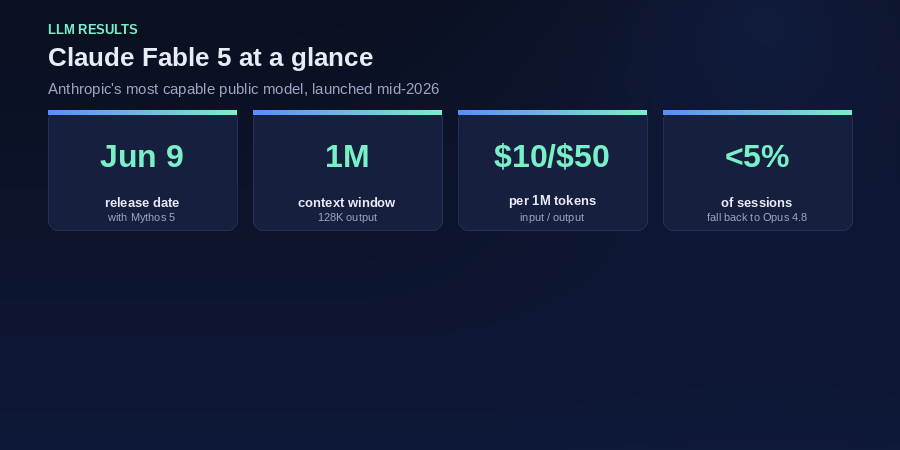
Opus 4.8 is Anthropic's Opus-tier workhorse — a highly capable 1M-token model priced at $5 / $25 per million input / output tokens. Fable 5 sits above it. It's the public face of Anthropic's frontier research line, offering measurably higher performance on the hardest reasoning, long-horizon agentic, and coding tasks, at a premium price of $10 / $50 per million tokens. Both carry a 1M-token context window and up to 128K tokens of output. The practical rule: reach for Opus 4.8 for most production work, and Fable 5 when a task is genuinely at the edge of what current models can do.
How does the safety fallback work?
Fable 5 is a Mythos-class model that Anthropic judged too capable to release without guardrails. Rather than degrade the model, Anthropic wraps it: when a request touches a restricted area — currently most biology and chemistry topics — the response is served by Claude Opus 4.8 instead. Anthropic reports this fallback triggers in fewer than 5% of sessions on average. For everything else, you get the full frontier model. On the API this behaviour is configurable through the server-side fallback mechanism, and a declined request returns a refusal stop reason rather than an error.
Fable 5 is the first widely released Claude that ships with a routing layer between the user and the model. Most requests reach the frontier model directly; a narrow band of sensitive topics is transparently handled by Opus 4.8. It's a deliberate trade — near-frontier capability for the public, with the most dual-use questions routed to a more constrained model.
Why did Fable 5 briefly disappear?
Fable 5 and its restricted sibling Claude Mythos 5 launched together on 9 June 2026 under U.S. export controls, which limited who could access them. Those controls were lifted on 30 June 2026, and from 1 July Fable 5 became available to users globally across the Claude API, Claude.ai, Claude Code, and Claude Cowork, as well as Amazon Bedrock, Claude Platform on AWS, Google Cloud, and Microsoft Foundry. The brief window when the model was pulled and then redeployed is why you may have seen conflicting reports about its availability.
Fable 5 versus Opus 4.8 at a glance
| Attribute | Claude Fable 5 | Claude Opus 4.8 |
|---|---|---|
| Positioning | Frontier flagship | Opus-tier workhorse |
| Context window | 1M tokens | 1M tokens |
| Max output | 128K tokens | 128K tokens |
| Price (input / output per 1M) | $10 / $50 | $5 / $25 |
| Extended thinking | Always on | Adaptive |
| Sensitive-topic handling | Falls back to Opus 4.8 | Direct |
What Fable 5 means for getting cited by AI
For anyone optimizing for AI visibility, the arrival of a frontier public model changes the ceiling on what AI answer engines can do, not the fundamentals of how to earn a citation. A more capable model reads more of your page, reasons more carefully about which source to trust, and synthesises longer answers — which rewards content that is specific, well-sourced, and self-contained. The winning strategy is unchanged: answer the question directly in the first paragraph, source your claims, and keep the page machine-readable. Frontier models are better at spotting the difference between a real answer and filler.