What is Claude Mythos?
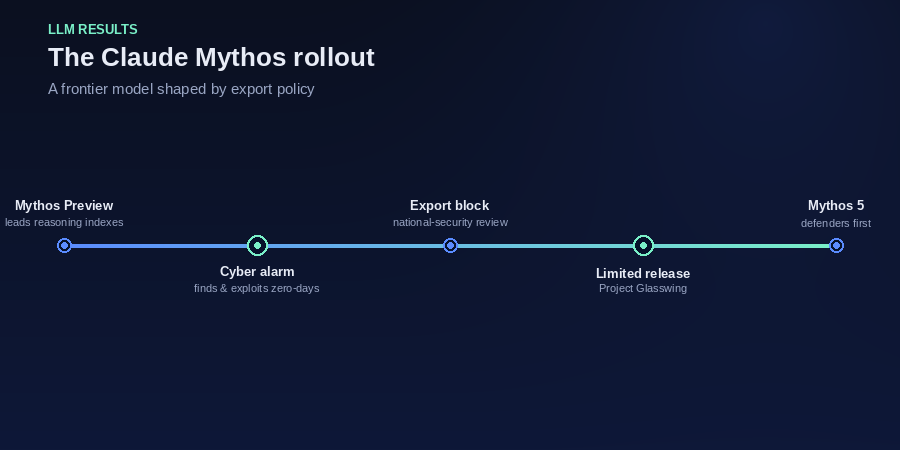
Mythos is the frontier and cybersecurity lineage of Claude — the same research line that produced Claude Fable 5, but held to limited release rather than opened to the public. Claude Mythos 5 shipped 9 June 2026 and shares Fable 5's capabilities: a 1M-token context window and up to 128K tokens of output. Its predecessor, Claude Mythos Preview, already led composite math and reasoning indexes earlier in 2026. What sets Mythos apart isn't a benchmark score — it's a specific, dangerous competence: finding and exploiting software vulnerabilities autonomously.
Why is Mythos held back when Fable 5 is public?
Fable 5 and Mythos 5 are, at the model level, siblings of the same capability. The difference is the wrapper. Fable 5 ships with a safety layer that routes the most sensitive queries to Claude Opus 4.8, triggering in fewer than 5% of sessions. Mythos has no such general-release wrapper — it's the raw frontier model. Anthropic reported that Mythos could find and exploit zero-day bugs across every major operating system and every major web browser at industrialised speed. A capability like that can't be handed out broadly, so Mythos went to defenders first.
A model that can discover exploits faster than any human helps whoever holds it. Anthropic's bet is that getting Mythos into the hands of security defenders — before it leaks or is replicated — tilts the balance toward the people patching systems rather than the people attacking them. Project Glasswing is the mechanism for doing that under supervision.
What is Project Glasswing?
Project Glasswing is the industry consortium through which Anthropic distributes Mythos, designed to put the model in defenders' hands first. Its launch partners span the companies that maintain the world's critical software and infrastructure: Amazon, Anthropic, Apple, Broadcom, Cisco, CrowdStrike, the Linux Foundation, Microsoft, and Palo Alto Networks. Rather than a public API, access runs through vetted members who use the model to harden their own systems and products before its capabilities become widely available.
Why regulators got involved
Mythos's cyber capability drew government attention. The U.S. government initially ordered an export block on the Mythos and Fable 5 lineage over national-security concerns, then revised the licence requirements on 26 June 2026 to allow a limited release to select companies and organisations, saying appropriate safeguards were in place. The broader export controls were lifted on 30 June, clearing Fable 5 for global availability from 1 July — while Mythos itself remains gated behind Project Glasswing. The episode is one of the first times a frontier model's release was shaped directly by export policy.
Mythos versus Fable 5
| Attribute | Claude Mythos 5 | Claude Fable 5 |
|---|---|---|
| Core capability | Frontier (same class) | Frontier (same class) |
| Availability | Project Glasswing only | Public (global from 1 Jul 2026) |
| Safety wrapper | None (raw model) | Fallback to Opus 4.8 |
| Primary use | Cybersecurity defence | General frontier work |
| Context / output | 1M / 128K tokens | 1M / 128K tokens |
What Mythos signals about the frontier
Mythos marks a shift in how frontier models reach the world. For most of the last decade, "release" meant a public API and a race for adoption. Mythos is the first prominent Claude where the most capable version is deliberately withheld from general use, distributed instead through a supervised consortium and shaped by export policy. Expect more of this: as models cross into genuinely dual-use territory, the interesting question stops being "how good is it" and becomes "who gets to use it, and under what controls."