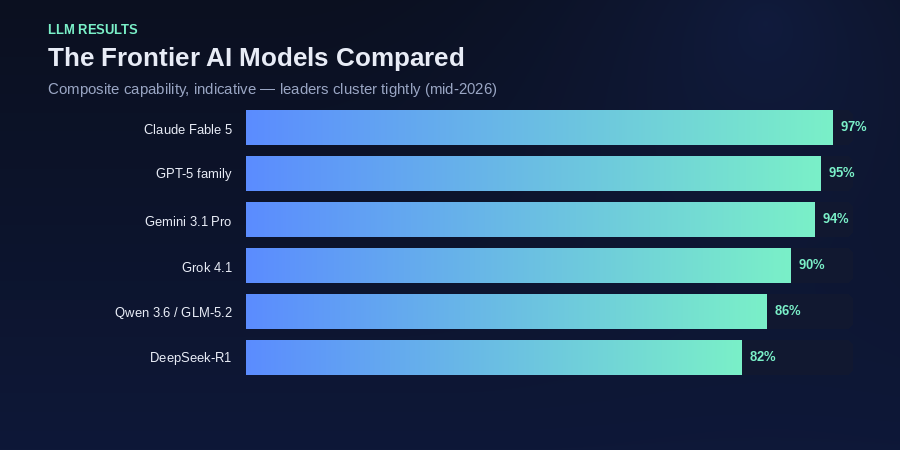
Who are the frontier labs in 2026?
Four Western labs define the closed-weight frontier — Anthropic (Claude), OpenAI (GPT-5), Google (Gemini), and xAI (Grok) — alongside a Chinese open-weight tier led by DeepSeek, Alibaba's Qwen, and Zhipu's GLM. The headline story of 2026 isn't one model pulling away; it's that the field has bunched at the top and split by specialty. Anthropic is the coding and writing specialist, OpenAI the versatile all-rounder with the deepest ecosystem, Google the multimodal reasoning-and-value play, and xAI the lean, agentic, cost-conscious option. Prices have fallen roughly 30–60% since 2025.
Anthropic: Claude Fable 5 and Opus 4.8
Anthropic runs a two-tier frontier. Claude Opus 4.8 is the widely deployed workhorse — a 1M-token model that leads on real-world coding and long-form writing, and is used most heavily in enterprise productivity and agentic workflows. Above it sits Claude Fable 5, released 9 June 2026, Anthropic's most capable public model and a "Mythos-class" system made safe for general use by routing sensitive queries to Opus 4.8. Anthropic's edge is instruction-following and careful, verifiable output — which is why it's the default choice where correctness matters more than raw speed.
OpenAI: the GPT-5 family
OpenAI unified its models into a single flagship GPT-5 line in early 2026, combining reasoning and general capability with a context window exceeding one million tokens and native computer use. It's the model behind ChatGPT, which OpenAI says reaches around 900 million weekly active users — by far the largest consumer reach of any lab. GPT-5 is the versatile all-rounder: rarely the single best at any one task, consistently near the top across all of them, and backed by the deepest tooling and integration ecosystem.
Google: Gemini 3.1 Pro
Gemini 3.1 Pro is Google's frontier entry and the model powering AI Overviews, which reach billions of users through Google Search. Its strengths are multimodal reasoning — image, video, and document understanding — and price-performance, aided by Google's own inference infrastructure. For any business whose customers rely on Google, Gemini matters twice over: as a standalone assistant and as the engine synthesising the AI Overview that now sits above the classic search results.
xAI: Grok 4.1
xAI's Grok has a structural advantage no rival can copy: native, real-time access to the full X data feed. For breaking news, market sentiment, and anything where recency beats depth, that's decisive. Grok 4.1 Fast pushes the context window to two million tokens, and xAI positions the line as the lean, agentic, cost-conscious choice — among the cheapest models in the top tier on reasoning benchmarks.
The open-weight frontier
The gap between closed and open weights has narrowed to a matter of months. DeepSeek-R1 and its distilled variants remain the most widely deployed open models in production, prized for frontier-adjacent reasoning at a fraction of the cost. Alibaba's Qwen 3.6 leads several coding benchmarks outright and runs on your own hardware. Zhipu's GLM-5.2 tops open math leaderboards. For teams with data-residency constraints or cost ceilings, the open tier is now a genuine frontier alternative, not a compromise.
2026's frontier is defined by specialization, not dominance. Ask "best for what?" — Claude for coding and writing, GPT-5 for breadth and ecosystem, Gemini for multimodal and Google reach, Grok for real-time, open weights for cost and control. The right choice is a function of your task, not a leaderboard rank.
How they compare
| Model | Lab | Context | Best at |
|---|---|---|---|
| Claude Fable 5 | Anthropic | 1M | Frontier reasoning & agentic coding |
| Claude Opus 4.8 | Anthropic | 1M | Real-world coding, long-form writing |
| GPT-5 family | OpenAI | >1M | Versatility, ecosystem, consumer reach |
| Gemini 3.1 Pro | 1M+ | Multimodal reasoning, Google reach | |
| Grok 4.1 | xAI | 2M | Real-time data, cost-efficient agents |
| DeepSeek-R1 / Qwen 3.6 / GLM-5.2 | Open weights | Varies | Self-hosting, cost, task-specific leads |
Positioning reflects public benchmarks and lab claims as of mid-2026; frontier rankings shift monthly and specific benchmark numbers vary by source. Treat this as a map, not a scoreboard.
Which one should you optimize for?
You don't optimize for a model — you optimize for the answer engines built on top of them. ChatGPT runs on GPT-5, Google AI Overviews on Gemini, Claude.ai on Claude, and Perplexity on a mix. Because each engine retrieves and cites differently, a single model rarely decides where your content shows up. The practical move is to figure out which engines your buyers actually use, then write content that any capable frontier model can quote: answer-first, specific, sourced, and served as plain HTML.