How do AI engines search the web?
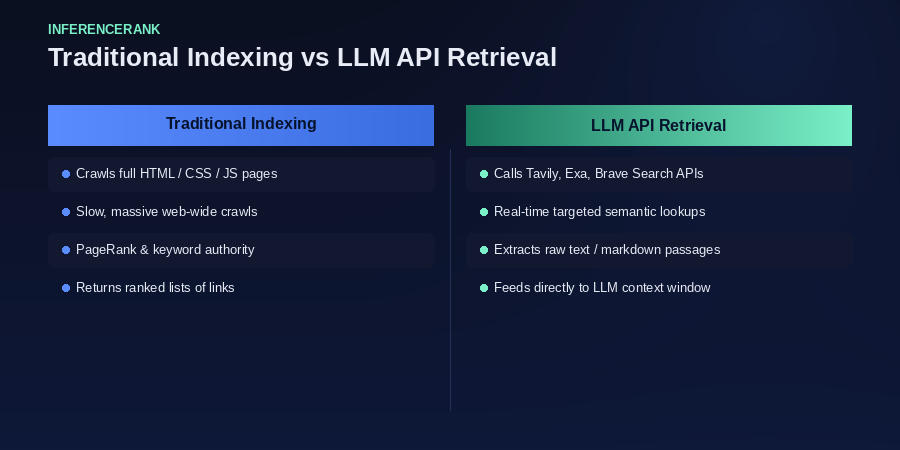
Traditional search engines spend billions of dollars running continuous, massive web-crawling operations to index the whole internet. When a user queries OpenAI's ChatGPT or Anthropic's Claude, these companies do not run a full web crawler in real time. Instead, when a model needs live info, it executes a programmatic call to a Web Search API. This API does the heavy lifting of searching its pre-indexed database, extracting the text from the top results, and returning it as clean Markdown or JSON directly into the model's context window.
The major players in LLM retrieval
Several specialized search APIs have emerged as the plumbing of the generative AI ecosystem. Each handles query retrieval differently:
- Tavily Search: Built specifically for LLMs and agentic workflows. It optimizes search queries, filters out noise (like ads and tracking code), and retrieves clean, raw text snippets from the web. It is widely used by developer frameworks like LangChain and LlamaIndex.
- Exa (formerly Metaphor): A neural search engine designed to search using natural language embeddings rather than keyword matching. Exa excels at understanding conceptual queries (e.g., finding "high-quality B2B case studies on pricing" rather than matching those exact keywords).
- Brave Search API: Serving as a highly private, independent index, Brave's API powers web search for several underdog models and privacy-focused assistants. Its index is fast, highly structured, and avoids the biases of the dominant traditional engines.
- Bing and Google Search APIs: The industry giants. Microsoft's Bing API powers ChatGPT's web search, while Google's Gemini utilizes Google's search index. They offer unmatched scale, though their APIs return data structured for traditional retrieval rather than direct LLM parsing.
Search APIs fetch raw HTML and parse it using automated scrapers to extract semantic text. They strip out menus, headers, footers, and scripts. If your content relies on client-side JavaScript to render, the search API retrieves an empty shell. To be indexable, your site must serve clean, server-side rendered (SSR) HTML.
What makes a page indexable by Search APIs?
Because search APIs need to respond in milliseconds to keep the LLM response time acceptable, they prioritize pages that load fast and are easy to parse. Heavy pages with excessive scripts, massive payloads, or poor layout hierarchies frequently timeout and are discarded by the API scraper. Semantically clean markup—using standard HTML5 headings (h1, h2, h3) and paragraph structures—allows the API to easily extract high-value passages to feed to the language model.
How to optimize for LLM Search APIs
Generative Engine Optimization (GEO) requires catering directly to the data pipelines that feed these APIs. First, make sure you use an llms.txt file at your domain root to guide crawlers to your most important summaries. Second, write in a direct, answer-first style: state the core fact immediately beneath your H2 headings. The cleaner and more structured your text is, the more likely a search API will extract your passage, and the more likely the LLM will select you as a cited source.
The short version
AI models search the web by calling specialized APIs like Tavily, Exa, and Brave. These APIs extract clean text, stripping away design, CSS, and client-side scripts. Optimizing for GEO means ensuring your site is fast, server-rendered, and structured so that API parsers can extract clear, citable passages instantly.