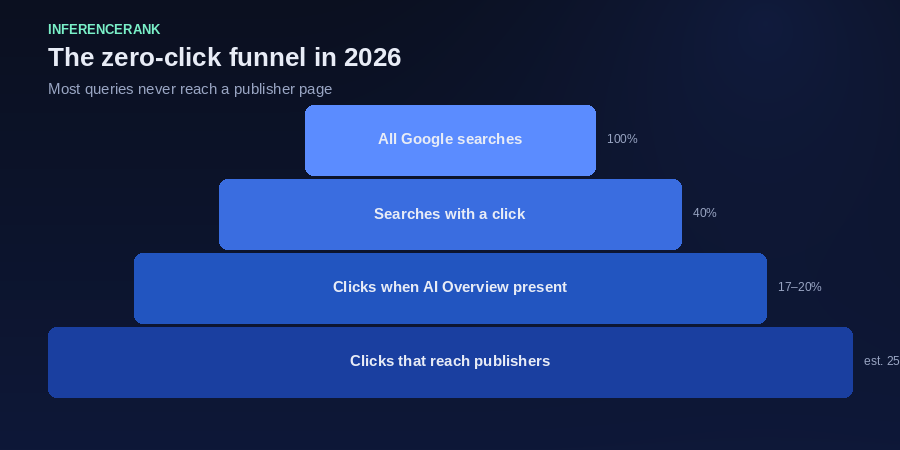
How widespread is zero-click search?
Zero-click searches — queries where users get what they need from the SERP itself and never visit a website — accounted for 68% of all Google queries in the first four months of 2026, up from 64.82% the year before, per SparkToro's analysis. When an AI Overview appears, the zero-click rate reaches 83%. Google's AI Mode — a newer, more conversational search surface rolling out in 2026 — pushes this to 93%. AI Overviews now appear on 58% of queries, up from just 12% in 2024. The consistent finding across methodologies is that well over two-thirds of search sessions no longer generate any web traffic at all.
How are publishers being affected financially?
The impact varies by publisher size and content category, but the data on individual cases is stark. HubSpot has publicly estimated it lost 70–80% of its organic traffic over the past year. The New York Times saw search's share of its traffic decline from 44% in 2022 to 37% in 2025. Across the broader publishing ecosystem, Google search referral traffic declined globally by approximately one-third in the year to November 2025. Some smaller specialist publishers have reported click-through rates dropping by as much as 89% on their core informational content — the exact queries that AI Overviews now answer directly.
The revenue damage compounds. Fewer page views mean fewer ad impressions. And the ad market for those impressions is weakening simultaneously, as Google captures a growing share of SERP ad inventory through AI Overview-adjacent placements — up from 5.17% of AI Overview SERPs in early 2025 to 25.5% by Q1 2026. Publishers lose on both sides: less traffic arrives, and when it does, Google has already sold the most valuable ad slot on the page that drove the visit.
Publishers that monetize through display ads tied to pageviews are most exposed. Publishers that monetize through email subscriptions, paid memberships, or direct service revenue are less vulnerable — their business isn't predicated on Google sending them traffic at scale. The structural shift rewards publishers who own their audience relationship.
Is AI-referred traffic worth less?
Counterintuitively, no. When users do click through from an AI-generated answer or citation, they arrive more informed and more intent-driven than a typical organic visitor. Benchmarks from 2026 show ChatGPT referrals converting at around 16%, Claude referrals at 16.8%, and Perplexity referrals at around 10.5% — compared to 1.76% for traditional Google organic traffic. AI-referred visitors also spend 48% longer on site and generate 37% higher revenue per visit than standard organic visitors.
The problem isn't the quality of AI-referred traffic — it's the quantity. Even at conversion rates ten times higher, the total economic value falls sharply if overall traffic drops 50–70%. The math only works if publishers can earn enough AI citations to compensate for the lost volume, or if they shift revenue models away from per-visit monetization.
What is actually working for publishers?
Publishers who are faring better share several characteristics. First, they have direct audience relationships through email lists, paid subscriptions, or community platforms that don't depend on Google sending traffic. Second, they produce content Google's AI cannot synthesize from other sources — proprietary data, original reporting, expert opinion, primary research. Third, for those still dependent on search traffic, they've prioritized being cited inside AI Overviews rather than just ranking below them. Brands cited in AI Overviews earn approximately 35% higher CTR than uncited competitors on the same queries — and AI-referred visitors convert at roughly 16% (ChatGPT referrals) to 16.8% (Claude referrals), versus 1.76% for traditional organic search traffic. Being in the answer, even when most users don't click, remains meaningfully valuable.
What does this mean for content investment?
Content designed to answer a generic question that AI can synthesize from a dozen sources has lost most of its economic value. Content that represents a unique data point, a primary source, or an authoritative perspective that the AI must cite because nothing else says it — that content has retained its value and may have gained it. The investment case for original research, proprietary benchmarks, and expert-authored analysis is stronger in 2026 than it was when everyone was competing on keyword density.
For content that must exist but can be synthesized from generic sources, the adaptation is structural rather than topic-based: write for citation rather than for ranking, make the key claim quotable in the first paragraph, and ensure AI crawlers can access the page. That won't recover all the lost traffic, but it recovers the economically meaningful portion of it.
Is the publisher business model salvageable?
The ad-supported, traffic-dependent model is under structural pressure that isn't reversing. The publishers adapting fastest are diversifying: adding subscription tiers, building direct-to-audience email products, developing paid tools or services built on their editorial expertise, and treating AI citation as a lead generation channel rather than a traffic channel. The ones most exposed are those who built scale on high-volume informational content with thin margins — that business model was viable when Google sent traffic; it isn't when Google answers the question itself.