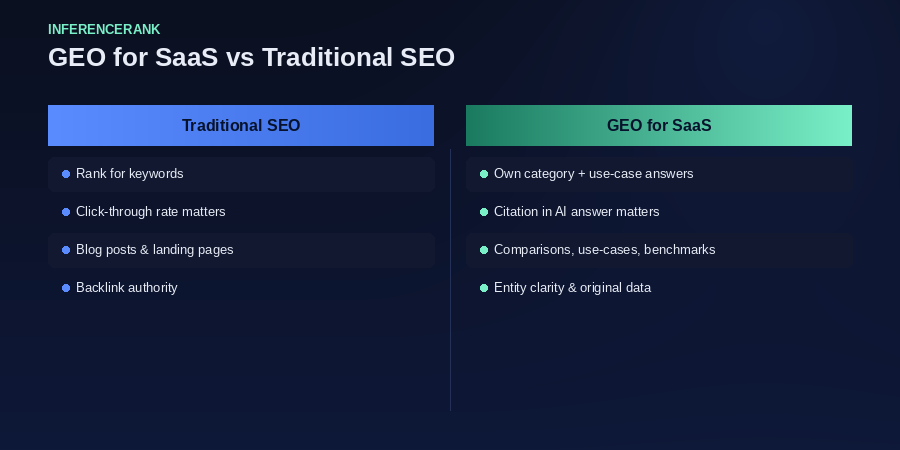
Why does GEO matter more for SaaS than for most categories?
Buyers of software are heavy AI users. They ask ChatGPT, Perplexity, and Claude for tool recommendations before they ever run a Google search — because they want a direct answer, not a list of vendor SEO pages to sift through. Webflow reports that 8% of their total signups now arrive from LLMs, and AI-referred traffic converts at roughly 6× the rate of Google search traffic. That gap exists because someone who clicked through from an AI recommendation has already been told the product fits their need. Gartner projects traditional search volume will drop 25% by end of 2026 as this shift accelerates. For SaaS specifically, missing AI citations isn't a future risk — it's a current revenue leak.
What types of queries do SaaS buyers ask AI engines?
The query types that matter most for SaaS break into four categories: category discovery ("what's the best tool for X"), comparison ("X vs Y"), use-case fit ("does X work for [job role] in [industry]"), and feature specifics ("how does X handle [capability]"). Each of these maps to a specific page type you need to own. If you don't have an authoritative answer published for that query shape, the AI will cite whoever does — which is usually a review aggregator or a competitor with more thorough documentation.
Which page types earn AI citations for SaaS products?
Comparison pages covering your product against named alternatives are the highest-leverage format. AI engines get asked "X vs Y" constantly and need a source to cite; a well-structured, honest comparison page — including where the competitor wins — is far more citable than a one-sided marketing page. Use-case pages scoped tightly ("X for marketing teams," "X for enterprise compliance") answer the job-role and industry qualifiers buyers add to their prompts. Integration pages document exactly how your product connects with adjacent tools — these get cited when buyers ask about their existing stack. Pricing and feature documentation written in plain, specific language outperforms vague feature lists every time.
A benchmark, a study, or a statistic that only you have published is the single most reliable way to get cited — because there's no other source to attribute it to. One proprietary data point, well-publicized, earns more citations than ten polished feature pages.
How do you build entity coverage for a SaaS product?
AI engines reason over entities — the named things in a topic and how they relate. For a SaaS product, your entities are: the product name, the product category, the primary use cases, the target customer types, the integrations, and the alternatives. Every one of these needs to be stated plainly somewhere on your site, not implied. A model that isn't sure whether your product is a project management tool or a CRM will hedge or skip you. A model that has read a page that says clearly "X is a project management tool for engineering teams, integrating with GitHub, Jira, and Slack, used by teams of 10–500" has what it needs to cite you confidently.
How do you measure whether GEO is working for your SaaS product?
Track citations directly: run your target buyer prompts across ChatGPT, Perplexity, Claude, Gemini, and Google AI Overviews on a regular cadence, document which sources get cited, and note when yours does or doesn't appear. Tools like Profound, Otterly AI, and Scrunch automate this across engines and alert you when citations change. The metric to watch is share-of-answer: for the queries that matter to your buyers, what fraction of AI responses name you? That's your GEO scoreboard, and it's independent of organic rankings.
The short version
Own the comparison pages, write tight use-case guides, document integrations and features in plain specific language, publish original data, and state your entity profile clearly. Then track citations per query to know what's working. That's GEO for SaaS.